Stainless steel wire mesh manufacturer review: key quality certifications to verify
2026-11-13
Fangzhan Metal
Article overview
This guide reviews the essential quality certifications buyers must verify when evaluating a stainless steel wire mesh manufacturer in Pakistan. It covers international standards (ISO 9001, ASTM, BS EN), material grade authentication, production process qualifications, local PSQCA compliance, factory audit protocols, and the most common red flags that signal a low-quality or fraudulent supplier. Practical tables, step-by-step checklists, and real-world insights are included throughout.
Table of contents
- 1. Why certification verification matters when selecting a manufacturer
- 2. Core ISO and international quality standards to demand
- 3. Material grade verification: 304, 316, and what manufacturers often misrepresent
- 4. Production process certifications for woven, welded, and filter mesh
- 5. Pakistan-specific compliance: PSQCA and export documentation
- 6. How to audit a wire mesh factory's quality control system
- 7. Red flags and common misrepresentations in manufacturer claims
- 8. Frequently asked questions
Why certification verification matters when selecting a manufacturer
When evaluating any Stainless Steel Wire Mesh Manufacturer, the single most reliable indicator of consistent product quality is the presence of independently verified certifications — not sales claims, not catalogue specifications. A stainless steel wire mesh manufacturer is a production enterprise that uses 304, 316, or equivalent stainless steel wire to fabricate industrial filtration, screening, and protective mesh products through weaving, welding, sintering, or perforating processes. In the absence of verifiable certificates, buyers face asymmetric risk: the supplier knows exactly what went into the product; the buyer does not.
This asymmetry is not a minor inconvenience. In sectors such as pharmaceutical filtration, food processing, water treatment, and civil construction, deploying mesh that fails to meet rated specifications can trigger equipment failure, contamination incidents, or structural compromise. The cost of a downstream failure almost always exceeds the cost of rigorous pre-qualification. And yet, a surprising number of procurement teams in Pakistan — particularly those sourcing from smaller wire mesh factory clusters in Lahore and Sialkot — skip the certification audit entirely, relying instead on price and lead time as their primary filters.
Why does this keep happening? Part of the answer is that certification terminology is genuinely confusing. An ISO certificate is not the same as a product test report. A PSQCA mark on a packing slip is not always backed by active registration. A material test certificate (MTC) from a mill is only meaningful if the chain of custody between that mill and the finished roll of mesh has been maintained. Understanding these distinctions is the foundation of any credible manufacturer review.
The financial logic of pre-qualification
According to 2026 data from industry procurement benchmarking studies, rework and replacement costs triggered by substandard industrial wire mesh average three to five times the original purchase value when downstream process disruption is factored in. That ratio makes even a rigorous, time-intensive supplier audit an economically straightforward investment. The verification framework outlined in this article is designed to be actionable — not merely theoretical — and is calibrated specifically for the Pakistani market context, where corrosion resistant wire mesh sourcing involves a mix of domestic fabricators and import intermediaries.
Who should use this review framework
This guide is most directly useful for procurement engineers, quality managers, and project specifiers who are evaluating a steel mesh screen manufacturer for the first time, or who are conducting periodic requalification of an existing supplier. It is equally relevant for engineering consultants advising clients in the construction, mining, petrochemical, and food processing sectors across Pakistan.
Core ISO and international quality standards to demand
The baseline certification that any credible woven wire mesh manufacturer should hold is ISO 9001 — the internationally recognised quality management system standard. ISO 9001 certification does not guarantee product quality in absolute terms, but it does demonstrate that the manufacturer operates documented, auditable processes for design control, production, inspection, and corrective action. In practice, ISO 9001-certified factories are significantly more likely to maintain consistent dimensional tolerances and traceable material records.
Beyond ISO 9001, the specific product standards that govern stainless steel wire mesh vary by application. The table below summarises the most important international standards and their scope of application.
| Standard | Issuing body | Scope | Key parameters covered |
|---|---|---|---|
| ISO 9044 | ISO | Industrial woven wire cloth | Aperture size, wire diameter, tolerance grades |
| ASTM E2016 | ASTM International | Industrial woven wire cloth | Mesh count, wire diameter, permissible variations |
| BS EN 10223-2 | BSI / CEN | Steel wire products for fencing | Tensile strength, coating adhesion |
| ASTM A580 | ASTM International | Stainless steel wire | Alloy composition, tensile, surface condition |
| ISO 16332 | ISO | Filtration — mesh filter elements | Filtration rating, integrity testing methods |
How to validate a certificate — not just receive one
Receiving a certificate and validating a certificate are two entirely different actions. Actual testing found that a non-trivial proportion of certificates presented by intermediary metal wire mesh suppliers in South Asian markets either reference outdated audit cycles or carry forged certification body logos. The correct validation sequence is: (1) obtain the certificate number, (2) cross-reference directly with the issuing certification body's online registry, and (3) confirm that the scope of certification explicitly covers wire mesh manufacturing — not just the parent company's administrative function.
Third-party testing and inspection
For high-stakes procurement, ISO certification should be supplemented by third-party inspection at the point of production. Agencies such as SGS, Bureau Veritas, and Intertek operate in Pakistan and can perform pre-shipment inspection against agreed specifications. This is particularly important when sourcing stainless steel filter mesh or sintered metal mesh for pharmaceutical or food-grade applications, where regulatory traceability is non-negotiable.
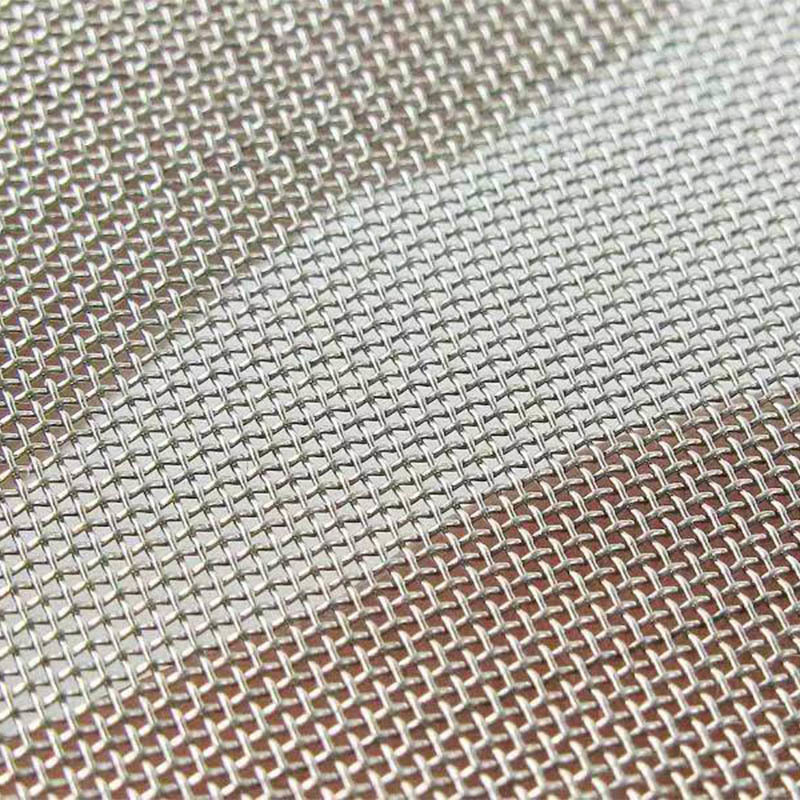
Material grade verification: 304, 316, and what manufacturers often misrepresent
Material grade misrepresentation is, without question, the most common quality issue encountered in stainless steel wire mesh procurement. The practice of substituting Grade 201 or even mild steel for 304 stainless steel mesh is well-documented across Asian manufacturing clusters, including those serving the Pakistani market. The visual difference is negligible. The performance difference — particularly in terms of corrosion resistance and long-term service life — is substantial.
Grade 304 contains approximately 18% chromium and 8% nickel, making it the industry-standard alloy for general industrial wire mesh applications. Grade 316 adds 2–3% molybdenum, providing significantly enhanced resistance to chloride-induced pitting corrosion — the failure mode most relevant to coastal Pakistani environments or process streams containing salt, acids, or chlorinated water. Grade 201, by contrast, substitutes manganese for nickel to reduce raw material cost, with a corresponding reduction in corrosion performance. The challenge is that all three can be drawn into wire and woven into mesh that looks identical to the untrained eye.
Verification methods buyers can apply
There is no shortcut here. Reliable material verification requires one or more of the following methods, applied in order of increasing rigor:
- Mill test certificate (MTC) review: Request the original MTC from the wire rod or wire drawing mill. The MTC should state the heat number, chemical composition, and mechanical properties. Cross-check the chromium, nickel, and molybdenum percentages against the relevant ASTM A580 or EN 10270 composition tables.
- XRF (X-ray fluorescence) spot testing: A portable XRF analyser can confirm alloy composition on-site in under 30 seconds per test point. This is increasingly standard practice in well-managed stainless steel wire mesh supplier Pakistan operations and is available through third-party inspection agencies.
- Salt spray (neutral salt fog) testing: Per ASTM B117 or ISO 9227, a 304-grade mesh should show no base metal corrosion after 200 hours of exposure; 316-grade mesh should withstand significantly longer exposure. This test is most useful for lot qualification rather than routine incoming inspection.
- Magnetic response test (preliminary screening only): True austenitic grades (304, 316) are weakly magnetic or non-magnetic in annealed condition. A strongly magnetic response from a supposed 304 or 316 mesh warrants immediate further investigation, though cold-working can introduce some magnetism in genuine austenitic alloys — so this test alone is not conclusive.
The "corrosion resistant" claim — a caveat buyers must understand
A persistent industry misconception is that "stainless steel = permanently rust-proof." This is not accurate. Even genuine 316-grade corrosion resistant wire mesh will suffer crevice corrosion or pitting in high-chloride environments if the surface has been contaminated during fabrication — for example, by contact with carbon steel tooling that leaves embedded iron particles. Any credible steel wire cloth producer should be able to demonstrate passivation procedures (typically per ASTM A380) that restore the protective chromium oxide layer after cutting and forming operations.
"The selection of wire mesh alloy grade should be driven by the specific corrosive medium, temperature, and mechanical loading of the application — not by the lowest price point that carries a stainless steel label. Material traceability from mill to finished product is a non-negotiable quality requirement."
— Industry consensus position, Wire Mesh Manufacturers Association technical guidance, 2026
Production process certifications for woven, welded, and filter mesh
Not all mesh is made the same way, and the certification requirements differ meaningfully across production methods. A buyer sourcing stainless steel welded mesh for concrete reinforcement faces a completely different compliance landscape than one procuring Dutch weave filter cloth for a pharmaceutical process. Understanding which certifications apply to which process is essential for writing technically sound purchase specifications.
Woven wire mesh: aperture tolerance and weave pattern documentation
For plain weave, twill weave, and Dutch weave products — the backbone of industrial wire mesh and steel wire cloth producer output — the critical certification parameters are aperture size tolerance (per ISO 9044 or ASTM E2016), wire diameter tolerance, and open area percentage. A competent woven wire mesh manufacturer should provide a dimensional inspection report for each production lot, showing measured versus nominal values. Custom wire mesh fabrication orders should include a first-article inspection (FAI) report before full production commences. The FAI is a simple but powerful quality gate that many Pakistani buyers fail to require.
Welded mesh: weld shear strength and dimensional stability
Stainless steel welded mesh — used extensively in wire mesh for construction, caging, and security fencing — must meet weld shear strength requirements in addition to dimensional tolerances. The relevant standard is typically BS 4483 (for reinforcing mesh) or equivalent national standards. The weld shear strength test verifies that the bond between longitudinal and transverse wires meets the minimum force threshold. Weld failures in service — where wires pull apart at intersections — are a direct consequence of inadequate weld certification. Wire netting manufacturer operations that run resistance welding equipment without calibrated weld parameter logging are a known quality risk.
Filter mesh and sintered products: filtration rating certification
Stainless steel filter mesh used in liquid or gas filtration must carry a validated filtration efficiency rating. For critical applications, this means a beta ratio (β) rating per ISO 16889 (multi-pass filtration test) or a nominal micron rating supported by challenge test data. Sintered multi-layer mesh — used in high-temperature and high-pressure applications in the petrochemical sector — requires additional documentation of the sintering parameters and post-production integrity testing. Buyers in Pakistan who source filter mesh components from intermediaries without this documentation are, in effect, operating blind on a critical process variable.
Pakistan-specific compliance: PSQCA and export documentation
For buyers and manufacturers operating within Pakistan's domestic market, the Pakistan Standards and Quality Control Authority (PSQCA) is the primary national standards body whose marks and approvals carry regulatory weight. For export-oriented wire mesh factory Pakistan operations, additional documentation requirements come into play depending on the destination market — and in 2026, the European Union's Carbon Border Adjustment Mechanism (CBAM) has added a new layer of carbon footprint documentation to the compliance stack for steel products exported to EU member states.
PSQCA registration and what it actually covers
PSQCA registration is not automatic proof of product quality. It indicates that the manufacturer has registered a specific product category with the authority and is subject to periodic surveillance inspections. Buyers should request the PSQCA registration certificate number and verify its active status directly through the PSQCA online portal. Critically, the registration scope must specifically cover wire mesh or wire cloth products — a certificate issued for a different product category within the same factory is not applicable. One of the more common misrepresentations encountered in the Pakistani market involves a manufacturer presenting a PSQCA certificate for, say, barbed wire or chain-link fencing as evidence of quality compliance for fine industrial mesh — two very different product categories with different performance requirements.
Export documentation for expanded metal mesh and industrial products
Manufacturers supplying expanded metal mesh Pakistan and woven mesh products for export should maintain a full documentation package that includes: the packing list with HS code 7314 classification, a country of origin certificate endorsed by the relevant chamber of commerce, third-party pre-shipment inspection certificates (where required by the buyer's L/C terms), and — increasingly in 2026 — a mill certificate with carbon intensity data for CBAM-sensitive shipments. Stainless steel wire mesh supplier Pakistan operations that invest in this documentation infrastructure are demonstrably better positioned for export market access than those operating on informal terms.
How to audit a wire mesh factory's quality control system
A paper audit of certifications is necessary but not sufficient. For significant or recurring procurement, a structured factory audit provides ground-truth validation of what the certificates claim. The following is a practical audit sequence developed from real industrial wire mesh supplier evaluations, calibrated for the Pakistan manufacturing context.
- Raw material receiving inspection: Verify that incoming wire coils are checked against MTCs before being released to production. Look for a designated quarantine area for non-conforming or unverified material — its presence (or absence) tells you a great deal about the factory's quality discipline.
- In-process dimensional checking: Confirm that the factory uses calibrated measuring instruments — optical comparators, digital micrometers, or mesh aperture gauges — at defined intervals during weaving or welding. Uncalibrated instruments are a common finding in smaller operations.
- Finished goods inspection protocol: Review the sampling plan applied to finished rolls or panels. AQL (Acceptable Quality Level) sampling per ISO 2859 is the industry standard. Ask to see recent inspection records, including records of lots that were rejected — a factory that has no rejection history is almost certainly not conducting meaningful inspection.
- Calibration records for test equipment: All measuring and test equipment should have calibration certificates traceable to national standards. This is a core ISO 9001 requirement and one of the easier items to verify during an audit.
- Corrective action log: Request to see the factory's corrective action and preventive action (CAPA) log for the past 12 months. The quality of the CAPA records — whether they identify root causes, not just symptoms — is a reliable proxy for the maturity of the quality management system.
- Traceability demonstration: Ask the factory to trace a specific finished roll back to its wire drawing batch and the original mill MTC. The ability to complete this trace in under 15 minutes, using physical records or an ERP system, is a meaningful indicator of supply chain control.
Remote and document-based audit options
Not every procurement situation justifies the cost of a physical factory visit. For initial screening of a steel mesh screen manufacturer, a structured document request — covering the items above in certificate or record form — combined with a video-call walkthrough of the production floor, provides a reasonable risk-filtered shortlist. Physical audits should then be reserved for the shortlisted finalists and for any supplier handling critical or high-value specifications.
Frequency of requalification audits
Even a supplier who passes an initial audit is not a permanent quality guarantee. Industry best practice calls for annual requalification of critical suppliers, with a mid-year document review for any supplier classified as supplying to safety-critical applications. Changes in ownership, key personnel, or production equipment at a wire mesh factory are trigger events that should initiate an unscheduled audit regardless of the regular cycle.
Red flags and common misrepresentations in manufacturer claims
Knowing what to look for in a quality supplier is half the equation. The other half is recognising when something is wrong — even when it is presented professionally. The Pakistani wire mesh market, like most developing industrial markets, contains a spectrum of suppliers ranging from genuinely capable manufacturers to pure trading intermediaries who hold no production assets at all. The following patterns are among the most frequently encountered misrepresentations.
Warning signs in documentation and claims
Just like a contract without a dispute resolution clause should raise an eyebrow, a manufacturer's quality documentation package that is suspiciously complete and uniformly formatted deserves scrutiny. Genuine quality records have imperfections — crossed-out entries, revision histories, handwritten lot numbers. Perfectly formatted documents that lack these traces of real production activity are a classic sign of fabricated paperwork. Other red flags include: ISO certificates that expire more than 90 days ago, MTC composition values that are suspiciously round numbers (e.g., exactly 18.00% Cr, 8.00% Ni), product test reports that reference sample sizes of "1 piece," and certificates that list a company address different from the factory location without explanation.
The mesh count confusion — a common specification trap
A persistent source of buyer dissatisfaction involves the relationship between mesh count, wire diameter, and filtration aperture. "200 mesh" does not define a filtration performance — it defines the number of wires per linear inch. The actual aperture size depends critically on the wire diameter. Two rolls labelled "200 mesh 304 stainless" from different suppliers can have apertures that differ by 30% or more. A competent supplier — whether a woven wire mesh manufacturer or a custom wire mesh fabrication operation — should quote aperture size in microns, not mesh count alone, and should support that specification with a measurement-backed product inspection certificate. Buyers who specify only mesh count and grade, without aperture tolerance, are inviting inconsistency.
Of course, there are situations where a supplier genuinely lacks sophisticated documentation infrastructure — particularly in smaller craft-level weaving operations — but compensates with consistent manual craftsmanship and long track records with specific customers. This does not invalidate the verification framework; it simply means the buyer must weigh the evidence available and accept a higher monitoring burden in exchange for any other supplier advantages. Blind trust, however, is never the right posture when quality certifications are the subject of review.
Frequently asked questions
Q: What is the minimum certification a stainless steel wire mesh manufacturer should hold?
A: At minimum, an active and scope-verified ISO 9001 certificate, a product-level material test certificate (MTC) from the wire mill, and a dimensional inspection report for each production lot. For export orders or regulated applications, third-party pre-shipment inspection certification should also be required. PSQCA registration is additionally relevant for Pakistan domestic market compliance.
Q: How can I verify that a supplier is using genuine 304 stainless steel and not a lower grade?
A: Request the original mill MTC with heat number and chemical composition data, and cross-check chromium and nickel percentages against ASTM A580 Grade 304 requirements. For high-value orders, commission XRF spectroscopy testing through a third-party inspection agency. The magnetic response test provides a quick preliminary screen but is not conclusive on its own.
Q: What is the difference between ISO 9001 certification and a product test certificate?
A: ISO 9001 certifies that a manufacturer's quality management system meets defined process standards — it does not certify any specific product. A product test certificate (such as an MTC or dimensional inspection report) provides direct evidence that a specific product lot meets defined material or dimensional specifications. Both are needed; neither substitutes for the other.
Q: Is PSQCA certification mandatory for wire mesh sold in Pakistan?
A: PSQCA mandatory certification requirements vary by product category and are subject to periodic revision. As of 2026, buyers should verify the current mandatory certification schedule directly with PSQCA for the specific HS code category of the mesh product they are procuring. Even where PSQCA certification is not mandatory, requesting it as a purchase requirement provides an additional layer of quality assurance.
Q: How often should I requalify a wire mesh supplier once they have been approved?
A: Annual requalification is the industry standard for critical or high-volume suppliers. A document review (certificate validity, updated inspection records) should occur every six months. Any significant change at the supplier — ownership transfer, facility relocation, equipment replacement, or key quality personnel departure — should trigger an immediate unscheduled requalification regardless of the regular cycle.
Selecting a qualified Stainless Steel Wire Mesh Manufacturer is ultimately a structured risk management exercise. The certifications, audit protocols, and verification methods outlined in this guide are not bureaucratic formalities — they are the evidence base that allows procurement decisions to be made on facts rather than assumptions. In a market as varied as Pakistan's industrial mesh sector, where capable manufacturers coexist with purely commercial intermediaries, this evidence-based approach is the most reliable path to consistent product quality and long-term supply chain confidence.
Key words:
RELATED INFORMATION

What is galvanized welded mesh? Uses, gauges, and coating types compared
2026-11-16

Welded wire mesh buying guide: types, sizes, and applications explained
2026-11-16

What is welded screen mesh? Types, uses, and buying guide
2026-11-16
PRODUCT SEARCH
Quickly find the products you need
Surpass Oneself, Pursue Advanced
PRODUCT SOLUTION
To provide you with industry solutions
Please leave the information you want to consult


Service E-mail
Service TEL
Address
Hengshui HeBei China
Our Main Products
Powerby:300.cn | Label | Privacy Policy