304 vs 316 stainless steel filter mesh: which grade suits your needs?
2026-11-13
Fangzhan Metal
Article overview
This guide compares 304 and 316 stainless steel filter mesh across corrosion resistance, mesh-to-micron conversion, weave structures, U.S. compliance standards, and filtration performance metrics — giving engineers and procurement teams a clear, data-backed decision framework for 2026.
Table of contents
- 1. What is stainless steel filter mesh? A quick definition
- 2. 304 vs 316: understanding the alloy difference
- 3. Corrosion resistance compared: where each grade performs
- 4. Mesh count, micron rating, and open area: the conversion guide you need
- 5. Weave types and filter structures: matching design to application
- 6. U.S. compliance standards and certifications that matter
- 7. Filtration performance: pressure drop, flow rate, and backwash cycles
- 8. Procurement essentials: MOQ, width, lead time, and cut-to-size options
- 9. FAQ
What is stainless steel filter mesh? A quick definition
Stainless steel filter mesh is a woven, sintered, or welded porous metal screen manufactured from stainless steel wire, used to separate solids from liquids or gases based on particle size. It combines the mechanical strength of steel with inherent corrosion resistance, making it the default choice across food processing, chemical refining, pharmaceuticals, and industrial liquid filtration environments. Unlike polymer filter media, a metal filter mesh can withstand elevated temperatures, repeated steam sterilization, and aggressive chemical cleaning without dimensional change.
The two alloys that dominate the market — 304 and 316 — look nearly identical on a warehouse shelf. Choosing the wrong one, however, can result in premature pitting corrosion, product contamination, or unplanned downtime. So which grade actually suits your needs? The answer depends on your process fluid, temperature, chloride exposure, and the regulatory framework your facility operates under. This guide breaks down every variable so you can make that call with confidence.
304 vs 316: understanding the alloy difference
The performance gap between 304 and 316 stainless steel comes down to a single alloying element: molybdenum. Grade 316 contains 2–3% molybdenum; grade 304 does not. That addition fundamentally reshapes the alloy's resistance to pitting and crevice corrosion in chloride-rich or acidic environments.
Alloy composition at a glance
| Element | 304 stainless steel | 316 stainless steel | 316L stainless steel |
|---|---|---|---|
| Chromium (Cr) | 18–20% | 16–18% | 16–18% |
| Nickel (Ni) | 8–10.5% | 10–14% | 10–14% |
| Molybdenum (Mo) | None | 2–3% | 2–3% |
| Carbon (C) max | 0.08% | 0.08% | 0.03% (low carbon) |
| PREN (pitting index)* | ~19–20 | ~24–26 | ~24–26 |
*PREN = %Cr + 3.3×%Mo + 16×%N. Higher values indicate greater pitting resistance. Source: ASTM A240 / industry standard calculation.
Why does the 316L variant matter for filter mesh?
316L's reduced carbon content (≤0.03%) prevents carbide precipitation along grain boundaries during welding or high-temperature processing — a phenomenon called sensitization that can create preferential corrosion paths in a woven wire filter screen. In sintered multi-layer filter construction, where mesh layers are bonded under heat and pressure, 316L is almost universally preferred over standard 316. Actual field experience in chemical process plants confirms that 316L sintered elements last measurably longer between replacement cycles compared with standard 316 equivalents exposed to acetic acid and chloride mixtures.
Corrosion resistance compared: where each grade performs
Corrosion resistance is the single most important selection criterion for a corrosion resistant filter mesh. The performance difference between 304 and 316 is not marginal — in the wrong environment, 304 can fail within weeks while 316 survives years.
Performance matrix across common process environments
| Environment | 304 rating | 316 / 316L rating | Notes |
|---|---|---|---|
| Freshwater / deionized water | ✅ Excellent | ✅ Excellent | Either grade suitable; 304 is cost-effective here |
| Seawater / salt spray (Cl⁻ >500 ppm) | ❌ Poor | ⚠️ Moderate | 316 resists pitting; duplex or 904L preferred for continuous immersion |
| Dilute sulfuric acid (<5%, <60 °C) | ⚠️ Marginal | ✅ Good | Mo addition significantly improves resistance |
| Phosphoric acid (<30%) | ⚠️ Marginal | ✅ Good | 316L preferred in food-grade fertilizer processing |
| Nitric acid (<10%) | ✅ Good | ✅ Good | 304 is typically sufficient and more economical |
| Caustic / alkaline (NaOH <25%) | ✅ Good | ✅ Excellent | Both perform well; 316L for higher concentrations |
| High temp steam (>300 °F / 150 °C) | ✅ Good | ✅ Good | Both retain tensile strength; 316L avoids sensitization in weld zones |
"Molybdenum is the decisive element. In chloride concentrations above 200 ppm, the PREN gap between 304 and 316 translates directly to a measurable difference in pitting initiation time — often an order of magnitude longer for 316." — Industry consensus summarized from ASTM Committee A01 technical bulletins and corrosion engineering reference standards.
Why do so many engineers still choose 304 when 316 seems clearly superior? Cost is the honest answer. According to 2026 market data, 316 stainless steel wire mesh typically runs 25–40% higher per square foot than equivalent 304 mesh. In low-chloride, near-neutral pH applications — think HVAC intake screens, grain handling, or general industrial dust filtration — that premium buys you nothing. Matching grade to environment, not simply defaulting to the higher specification, is sound engineering practice.
Mesh count, micron rating, and open area: the conversion guide you need
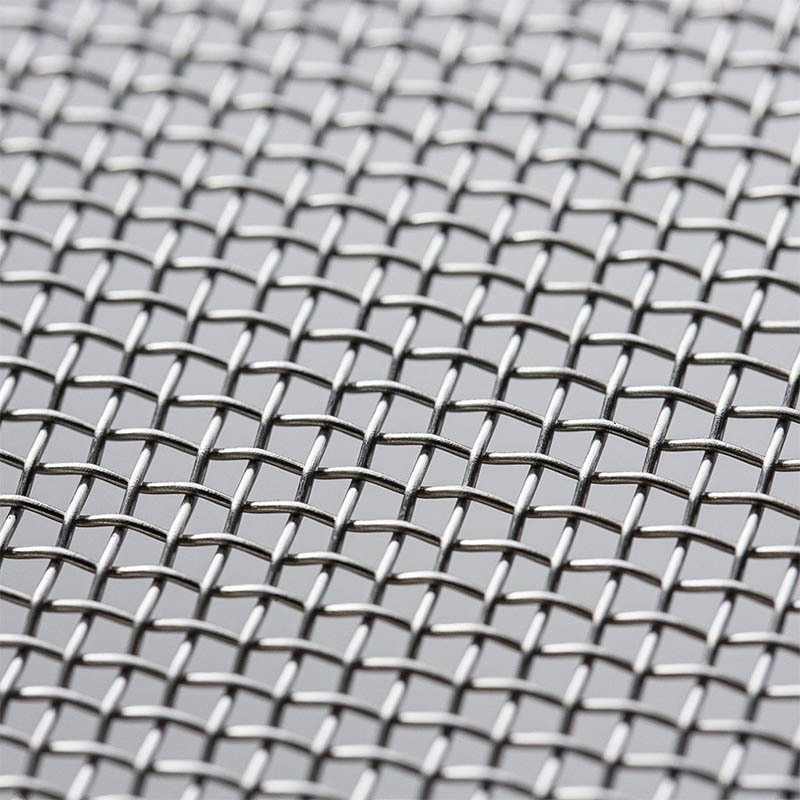
One of the most persistent sources of confusion in specifying a stainless steel wire mesh is the relationship between mesh count (the number of wires per linear inch), aperture size in microns (µm), wire diameter, and open area percentage. These four variables are interdependent — change one and the others shift.
The conversion formula
The fundamental aperture calculation for a plain weave mesh is:
Aperture (inches) = (1 / Mesh count) − Wire diameter (inches)
Aperture (µm) = Aperture (inches) × 25,400
Open area percentage — a critical parameter for pressure drop calculations — follows as:
Open area (%) = (Aperture / Pitch)² × 100
where Pitch = 1 / Mesh count
Mesh-to-micron reference table (plain weave, standard wire diameter)
| Mesh count (per inch) | Wire dia. (in.) | Aperture (µm) | Open area (%) | Typical application |
|---|---|---|---|---|
| 10 | 0.025 | 1,651 | 55% | Coarse pre-filtration, debris screens |
| 40 | 0.010 | 381 | 42% | General industrial strainer screen |
| 100 | 0.004 | 152 | 36% | Liquid filtration, food processing |
| 200 | 0.0021 | 74 | 33% | Fine mesh stainless steel filter, pharmaceuticals |
| 325 | 0.0014 | 44 | 30% | High-precision chemical filtration |
| 500 | 0.001 | 25 | 26% | Stainless steel filtration screen, semiconductor rinse |
A common industry misconception is that a higher mesh count always equals a finer filter. Wire diameter plays an equally decisive role. Two 200-mesh screens from different suppliers can have apertures differing by 30 µm or more if wire diameters differ — a variance large enough to pass or block a critical particle size. Always specify both mesh count and wire diameter, and verify against ASTM E2016 (Standard Specification for Woven Wire Test Sieve Cloth) when precision is mandatory.
Weave types and filter structures: matching design to application
The weave architecture of a stainless steel screen filter determines not just particle retention but also flow resistance, mechanical strength, and cleanability. Selecting the wrong structure for a high-pressure or viscous-fluid application is a costly mistake — one that shows up in shortened service life and inconsistent filtration quality.
Primary weave types and their characteristics
Plain weave (square weave): Each warp wire passes alternately over and under each weft wire. This produces a uniform square aperture, making it the standard for woven wire filter screen applications where consistent particle size cutoff is needed. Open area is relatively high, which keeps pressure drop low. Best suited for general-purpose industrial filter mesh applications in water treatment, HVAC, and light chemical filtration.
Twill weave: Each wire crosses over two and under two in sequence, creating a diagonal pattern. Twill weave allows finer wire diameters at equivalent mesh counts, enabling higher mesh numbers while maintaining structural integrity. A 400-mesh twill weave 316 stainless steel filter cloth is a standard specification in pharmaceutical and fine chemical applications.
Dutch weave (plain Dutch and twilled Dutch): Warp wires are coarser and more widely spaced; weft wires are finer and packed tightly. This creates a very small aperture without the fragility of an ultra-fine plain weave. Dutch weave mesh filter for liquid filtration is the preferred design where high differential pressure, high viscosity fluids, or fine particle retention down to 5–25 µm is required — common in hydraulic oil filtration, polymer extrusion, and resin processing.
Single-layer vs. sintered multi-layer filter structures
Single-layer woven mesh is economical and straightforward. For demanding applications — think high-temperature filter mesh service above 500 °F, or applications requiring absolute filtration ratings — sintered multi-layer construction is the engineering answer. Multiple layers of woven wire are stacked and bonded under heat and pressure, producing a rigid, precisely calibrated stainless steel filter cloth with nominal ratings as fine as 1–2 µm. The sintering process also eliminates loose wire ends, a critical requirement in food and pharmaceutical environments where metallic contamination risk must be zero. A stainless steel perforated filter plate is often used as the support layer in these assemblies, providing structural rigidity while the fine mesh layer performs the actual separation.
U.S. compliance standards and certifications that matter
Specifying the right alloy grade and weave type covers only part of the compliance picture. In the U.S. market, the standards governing dimensional accuracy, material verification, and end-use safety are specific and non-negotiable in regulated industries.
Key standards for stainless steel filter mesh in the U.S.
- ASTM E2016: Standard Specification for Woven Wire Mesh Cloth — defines aperture tolerances, wire diameter tolerances, and testing methodology. This is the primary dimensional standard referenced in engineering drawings and procurement specifications across industrial filter mesh applications in the U.S.
- ISO 9044: Industrial woven wire cloth — technical requirements and testing. Often specified in tandem with ASTM E2016 for export or multinational supply chains.
- FDA 21 CFR: For any stainless steel strainer screen in food or beverage contact service, materials must comply with FDA 21 CFR regulations governing metals in contact with food. 316L is the preferred alloy; documentation of material composition (mill cert) is required.
- 3-A Sanitary Standards: The 3-A SSI framework, widely adopted in U.S. dairy, beverage, and pharmaceutical processing, sets specific surface finish, crevice, and material requirements. Woven wire filter screens used in 3-A-compliant systems must meet these criteria — typically 316L with a minimum surface finish of 32 µin Ra.
- AS9100 / aerospace: For high-temperature filter mesh or stainless steel filtration screen components in aerospace and defense applications, AS9100 Rev D quality management system certification from the supplier is the baseline requirement. Material traceability to original mill certificates is mandatory.
2026 compliance landscape: PFAS regulations driving metal filter adoption
A notable 2026 trend: tightening EPA and state-level PFAS regulations are accelerating the shift away from PTFE-based and polymer filter media toward reusable metal filter mesh alternatives. Facilities in food processing, semiconductor manufacturing, and water treatment are actively re-specifying their filtration systems to avoid PFAS-containing materials — creating direct demand for 316L sintered mesh and fine-weave stainless steel filter cloth as drop-in replacements.
Filtration performance: pressure drop, flow rate, and backwash cycles
Selecting the correct grade and weave type is necessary but not sufficient. Understanding how a corrosion resistant filter mesh behaves under actual process conditions — specifically pressure drop, fluid viscosity effects, and backwash frequency — determines whether your system runs efficiently or struggles with constant interventions.
Estimating pressure drop across a woven wire filter screen
A simplified Ergun-based approach for pressure drop (ΔP) across a clean mesh filter:
ΔP ≈ (μ × v × L) / (k × d²)
Where: μ = dynamic viscosity (Pa·s), v = superficial velocity (m/s), L = filter thickness (m), k = permeability constant (mesh-dependent), d = aperture diameter (m)
In practical terms: as viscosity doubles, pressure drop doubles at the same flow rate. A 200-mesh fine mesh stainless steel filter handling a 50 cP polymer solution will generate dramatically higher pressure drop than the same mesh filtering water at 1 cP. This is why Dutch weave designs — with their higher packing density but engineered flow channels — outperform plain weave in viscous liquid applications despite nominally lower open area.
Backwash cycles and service life planning
How do you know when to backwash? The standard trigger is a differential pressure rise of 20–35% above the clean baseline — a threshold confirmed by real-world experience in continuous liquid filtration systems processing slurries and particulate-laden process streams. At that point, reverse-flow backwashing at 1.5–2× the forward flow rate effectively dislodges surface cake for most mesh sizes above 74 µm (200 mesh). Finer meshes below 50 µm often require ultrasonic cleaning or chemical soak protocols, particularly when handling sticky organic compounds or biological materials.
Of course, backwash intervals are highly application-specific. A high-solids mining slurry might demand backwashing every 2–4 hours; a clean pharmaceutical buffer solution might run 6–8 months between service events on the same mesh. Establishing a baseline ΔP curve during commissioning and trending it over 30 days gives a far more reliable service interval than any generic specification sheet.
Procurement essentials: MOQ, width, lead time, and cut-to-size options
Even the most perfectly specified stainless steel wire mesh becomes an operational problem if procurement terms don't match project realities. Here are the key commercial variables to confirm before issuing a purchase order.
Standard commercial parameters for industrial filter mesh
- Minimum order quantity (MOQ): For standard 304 stainless steel mesh in common mesh counts (10–200 mesh), MOQs typically start at 1–5 linear feet from stocking distributors. Custom mesh counts, 316L, or specialty Dutch weave orders usually require full-roll minimums, commonly 25–100 linear feet, depending on wire diameter and width.
- Standard roll widths: Most U.S. suppliers stock mesh in 36-inch, 48-inch, and 60-inch widths. Wider rolls (up to 120 inches) are available for high-volume industrial applications but typically require mill orders with 6–12 week lead times in the current 2026 supply environment, where U.S. tariff adjustments on imported stainless steel wire have extended some offshore lead times.
- Cut-to-size and fabrication services: Many suppliers offer shearing, laser cutting, edge folding, and framing services. For a stainless steel strainer screen or filter disc application, specifying the finished cut dimensions, edge treatment (raw cut, folded, or welded frame), and hole pattern avoids costly secondary fabrication. Confirm tolerances: laser-cut 316L mesh discs typically hold ±0.010 inch on OD; sheared sheet edges require edge smoothing for food-contact applications.
- Material certification: Always request a mill test certificate (MTC) per EN 10204 3.1 or 3.2 standard. This document confirms chemical composition, mechanical properties, and heat number traceability — mandatory for FDA, 3-A, and AS9100 applications. Stocking distributors should provide MTCs on request; be cautious of any supplier who cannot produce them.
- Lead times in 2026: Standard 304 and 316 stainless steel mesh in common sizes: 1–2 weeks from U.S. distribution stock. Custom 316L Dutch weave or sintered multi-layer panels: 4–8 weeks domestic, 8–14 weeks imported. Plan accordingly for maintenance shutdowns and new system builds.
How to write a complete mesh specification
A complete specification prevents ambiguity and avoids receiving the wrong product. Include: alloy grade (304, 316, or 316L), weave type (plain, twill, Dutch plain, Dutch twill), mesh count per inch in both directions (e.g., 200×200 or 200×600 for Dutch weave), wire diameter in inches or millimeters, finished dimensions and quantity, edge treatment, applicable standard (ASTM E2016 or ISO 9044), and certification level required (MTC 3.1 or 3.2). Providing this data upfront reduces quote turnaround time and virtually eliminates substitution errors.
Frequently asked questions
Q: Can I use 304 stainless steel filter mesh in a saltwater application?
A: Generally, no. In chloride concentrations above approximately 200 ppm — typical of seawater, brackish water, or coastal atmospheric exposure — 304 stainless steel mesh is susceptible to pitting and crevice corrosion. Grade 316 or 316L, with its molybdenum content raising the PREN to ~25, is the minimum specification for these environments. For continuous seawater immersion, duplex 2205 or alloy 904L should be evaluated.
Q: What is the difference between mesh count and micron rating?
A: Mesh count is the number of wires per linear inch; micron rating (aperture size in µm) is the actual opening between wires. They are related but not directly interchangeable — aperture depends on both mesh count and wire diameter. A 200-mesh screen typically corresponds to approximately 74 µm, but this can vary by ±15–20 µm depending on wire gauge. Always verify aperture size with the supplier's technical data sheet.
Q: Is 316L always better than standard 316 for filter mesh?
A: Not always — but in applications involving welding, sintering, or high-temperature heat cycles, 316L's lower carbon content prevents carbide precipitation at grain boundaries (sensitization), which can create localized corrosion pathways. For cold-formed or unwelded mesh used in ambient-temperature service, standard 316 and 316L perform identically. For sintered multi-layer filters or welded assemblies, specify 316L.
Q: What weave type should I choose for high-viscosity liquid filtration?
A: Dutch weave — either plain Dutch or twilled Dutch — is the standard choice for viscous fluid applications. Its asymmetric wire structure creates fine apertures with relatively low resistance per unit area compared to equivalent plain weave at the same nominal micron rating. Twilled Dutch weave in 316L is the dominant specification for hydraulic oil filtration, polymer processing, and resin systems where viscosity exceeds 50 cP.
Q: Which stainless steel filter mesh grade is required for FDA food contact compliance?
A: FDA 21 CFR regulations permit both 304 and 316/316L stainless steel for food contact applications. However, 316L is strongly preferred in the industry — and mandatory under 3-A Sanitary Standards for dairy and beverage equipment — because its superior corrosion resistance reduces the risk of metal ion migration into food products and makes passivation and CIP (clean-in-place) cleaning more reliable. Always request a mill certificate documenting alloy composition.
Conclusion: making the right choice for your application
The choice between 304 and 316 stainless steel filter mesh is not a question of which grade is universally better — it is a question of fit. In low-chloride, near-neutral pH environments, 304 stainless steel mesh delivers reliable service at a lower total cost. Step into chloride-rich, acidic, or high-temperature process conditions, and the molybdenum content in 316 and 316L earns its premium through meaningfully extended service life and reduced contamination risk.
Beyond alloy selection, the complete specification picture includes weave type matched to viscosity and pressure requirements, aperture size verified through the mesh-to-micron conversion formula rather than assumed from mesh count alone, and compliance documentation aligned with ASTM E2016, FDA, 3-A, or AS9100 as your application demands. Factor in procurement realities — roll widths, MOQs, cut-to-size tolerances, and the 2026 supply chain environment — and you have a framework that transforms a potentially confusing material selection into a systematic, defensible engineering decision.
When specifying stainless steel filter mesh for a new system or a maintenance replacement, use the tables and formulas in this guide as your starting point, verify against your actual process fluid chemistry, and always request mill certifications. The right mesh, properly specified, will outperform a default selection for years — and that is exactly where engineering value is created.
Key words:
RELATED INFORMATION

What is galvanized welded mesh? Uses, gauges, and coating types compared
2026-11-16

Welded wire mesh buying guide: types, sizes, and applications explained
2026-11-16

What is welded screen mesh? Types, uses, and buying guide
2026-11-16
PRODUCT SEARCH
Quickly find the products you need
Surpass Oneself, Pursue Advanced
PRODUCT SOLUTION
To provide you with industry solutions
Please leave the information you want to consult


Service E-mail
Service TEL
Address
Hengshui HeBei China
Our Main Products
Powerby:300.cn | Label | Privacy Policy