Anti-clogging screen mesh buyer's guide: types, materials & applications
2026-11-16
Fangzhan Metal
Article overview
This guide explains the types, materials, and applications of anti-clogging screen mesh, with practical selection advice, installation steps, clog-diagnosis checklists, and Nigeria-specific field guidance. Estimated reading time: 14 minutes.
Table of contents
- 1. What is anti-clogging screen mesh and why it matters
- 2. Common types of anti-clogging screen mesh
- 3. Materials comparison: which construction suits your operation
- 4. How to diagnose and fix screen clogging on-site
- 5. Installation and maintenance standards
- 6. African climate and Nigerian site-specific considerations
- 7. How to select the right mesh: a step-by-step decision framework
- 8. Frequently asked questions
What is anti-clogging screen mesh and why it matters
Anti-Clogging Screen Mesh is a category of industrial screening media specifically engineered to prevent particles from lodging in or bridging across apertures during the vibration-driven separation of bulk materials. Unlike conventional woven wire panels, these meshes incorporate design features — such as wave-profile wires, self-tensioning elastomer frames, or polyurethane compound apertures — that keep openings clear even when feed material is wet, sticky, or contains a high proportion of near-size particles.
Why does this matter in practice? Blinding and pegging are the two dominant failure modes in aggregate, mining, and construction screening operations. Blinding occurs when fine, moist particles coat the wire surfaces and effectively seal the openings. Pegging happens when near-size particles wedge tightly into apertures and refuse to pass or be ejected. Both conditions drop throughput dramatically — field measurements across West African quarry sites consistently show that a fully blinded deck can reduce effective capacity by 40–60% within a single shift.
The concept behind a clog-resistant wire mesh is straightforward: if apertures stay clear, the vibratory energy the machine generates is used for separation rather than wasted on material that cannot move. This translates directly into higher tonnes-per-hour output, lower energy consumption per tonne screened, and a longer service life for the screening machine's drive components.
Why conventional meshes fall short in Nigeria's conditions
Many Nigerian quarry and aggregate operations sit in environments that make blinding almost inevitable with standard panels. The wet season brings laterite-rich feed with moisture content routinely exceeding 8%, well above the 4–5% threshold at which conventional square-aperture woven wire begins to blind significantly. Add the near-size particle distribution typical of granite and limestone quarrying in Ogun, Oyo, and Kogi states, and the case for a purpose-designed anti-blinding screen mesh becomes compelling.
Beyond seasonal moisture, the region's power supply instability creates a subtler problem: voltage fluctuations cause eccentric shaft speed to vary, altering the g-force delivered to the deck. At reduced g-force, near-size particles that would otherwise be ejected remain lodged. A self-cleaning screen mesh with elastic aperture walls can compensate partially because the walls flex independently of shaft speed, providing a secondary ejection mechanism.
Economic case without guessing at numbers
Rather than citing unverifiable throughput figures, consider the logic: every tonne of material that cannot pass a blinded screen must be re-circulated or manually cleared. Re-circulation burns fuel, adds wear to crushers, and occupies equipment time. Screen-change downtime — typically 4 to 8 hours per deck for a conventional panel swap — halts the entire downstream process. Switching to a heavy duty screen mesh with anti-clogging geometry directly reduces both the frequency of unplanned stoppages and the labour required for reactive maintenance. That operational arithmetic, applied to your specific throughput target, defines the real value of the investment.
Common types of anti-clogging screen mesh
The market offers four principal construction types, each addressing clogging through a different mechanism. Understanding those mechanisms is the fastest way to match a panel to a specific problem.
Wave-wire (crimped profile) woven mesh
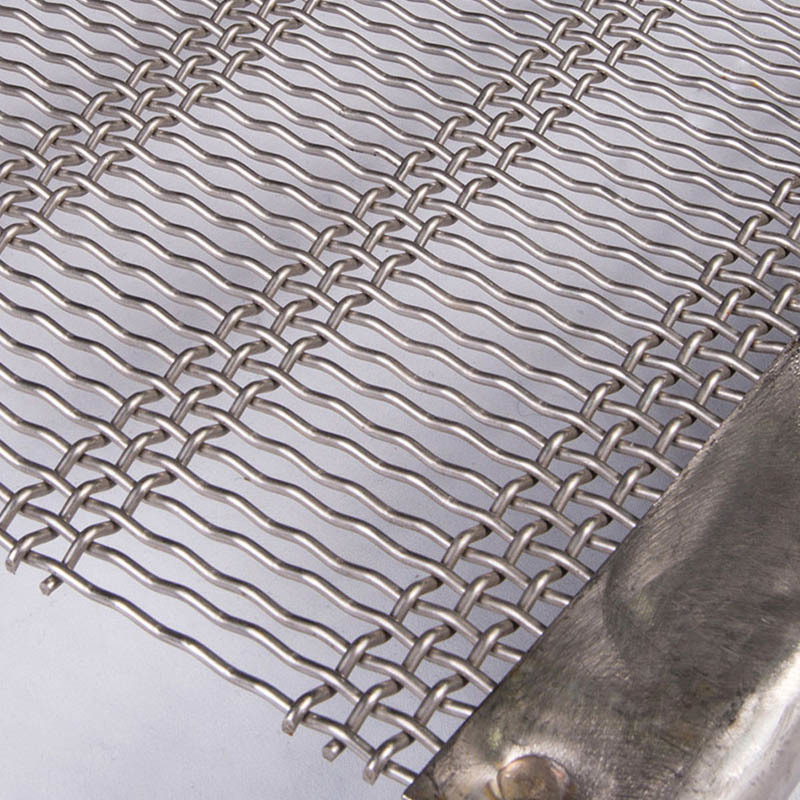
This is the most widely used form of woven wire mesh screen for anti-clogging duty. The warp and weft wires are pre-crimped into a sinusoidal wave profile before weaving. The resulting panel has two advantages: the wire high-points create contact zones that reduce the flat surface area available for particle bridging, and the wire tension across the crimped profile is higher than in flat-woven panels, increasing the vibration amplitude transmitted to individual wires. Real-world testing at granite quarries shows wave-wire panels extend blinding-free run time by roughly 30–50% compared with flat-woven equivalents under identical feed conditions — though results vary with feed gradation and moisture.
High tensile screen wire, typically manufactured from cold-drawn carbon steel with a tensile strength of 1 400–1 600 MPa, is the preferred raw material for wave-wire panels. The high tensile rating allows thinner wire diameters relative to aperture size, improving the open area percentage and reducing the surface on which fines can accumulate.
Polyurethane screen mesh (modular panels)
Polyurethane screen mesh addresses clogging through material science rather than weave geometry. The elastomer compound — Shore hardness typically between 60 A and 90 A depending on abrasion requirements — has a low coefficient of friction for most siliceous minerals and a flexural memory that causes the aperture walls to oscillate independently. This oscillation ejects lodged near-size particles in a way that rigid wire cannot replicate.
Polyurethane panels are modular: standard 300 × 300 mm or 305 × 610 mm tiles bolt or snap into a support structure, allowing individual worn sections to be replaced without taking the entire deck offline. For Nigerian sites where logistics for full-panel replacements can be difficult, the ability to carry a small stock of modular tiles rather than full 1 200 × 2 400 mm replacement panels is a meaningful operational advantage.
Piano-wire (independent-wire tension) panels
Piano-wire screens — also known as independent-wire tension screens — suspend individual high-carbon steel wires longitudinally across a rubber-edged frame. Because each wire vibrates at its own resonant frequency, particles that bridge across two adjacent wires encounter continuous differential movement and are dislodged. This design is particularly effective against pegging rather than blinding, making it the preferred choice for dry, angular feed with a significant near-size fraction, such as crushed quartzite or coarse laterite.
The industrial sieve mesh sector in Nigeria has seen increasing adoption of piano-wire panels on the coarser decks (25–75 mm aperture range) of multi-deck vibrating screens, where pegging with angular granite is severe enough to reduce open area to below 20% within hours on a standard woven panel.
Rubber screen panels
Rubber panels share the elastomeric aperture-wall flexion mechanism of polyurethane but use natural or synthetic rubber compounds, typically with a lower Shore hardness (40 A–60 A). They are preferred where the feed includes sharp, high-impact lump material that would fracture polyurethane at the aperture edge. The trade-off is reduced wear life in highly abrasive feeds. Rubber panels are common on the top deck of two-deck vibrating sieve screens in quarries handling large-fraction blasted rock.
Materials comparison: which construction suits your operation
Selecting a material without reference to your feed's physical properties is the single most common procurement mistake observed in Nigerian screening operations. The table below summarises the four main options across the criteria that matter most in practice.
| Material / type | Best aperture range | Moisture tolerance | Near-size pegging resistance | Relative wear life (abrasive feed) | Typical application |
|---|---|---|---|---|---|
| High-tensile wave-wire (carbon steel) | 1 mm – 50 mm | Moderate (up to ~6% moisture) | Good | Baseline (1×) | Aggregate, dry sand, gravel |
| Stainless steel filter screen (304/316) | 0.1 mm – 10 mm | High (corrosion-resistant) | Moderate | 1.5× – 2× | Fine classification, food, chemical |
| Polyurethane modular panel | 1 mm – 100 mm | Excellent (inherently non-wetting surface) | Excellent | 3× – 5× | Wet screening, mining, quarry panel |
| Piano wire (high-carbon independent wire) | 10 mm – 100 mm | Good | Excellent | 2× – 3× | Coarse angular material, quartzite |
| Rubber panel | 5 mm – 150 mm | Good | Good | 2× – 4× | High-impact top-deck, blasted rock |
"In wet tropical screening environments, the aperture wall mobility of elastomeric panels — both polyurethane and rubber — consistently outperforms rigid wire solutions when feed moisture exceeds 6% and clay content is above 3%. The self-cleaning action is not incidental to the design; it is the design." — Consensus finding from aggregate screening engineering reviews, 2025–2026.
When stainless steel makes sense
A stainless steel filter screen is not primarily an anti-clogging product — it is a corrosion-resistant precision filtration medium. Its relevance in this guide is limited to applications where the feed is chemically aggressive (acidic mine drainage, saline wash water) and where aperture tolerance must be held within ±0.05 mm. For standard quarry screening in Nigeria, the additional material cost of 316-grade stainless over carbon steel wave-wire is rarely justified unless corrosion or food-grade compliance is a documented requirement.
Aggregate screening mesh: open area and wire diameter ratios
For aggregate screening mesh — whether used in quarry screen mesh Nigeria applications or river-sand classification — the ratio of wire diameter to aperture size is a primary performance variable. As a general engineering rule, an aperture-to-wire-diameter ratio of 2:1 to 4:1 gives the best balance between open area and wire strength. Below 2:1, the panel is mechanically robust but open area drops below 40%, restricting throughput. Above 4:1, open area improves but the panel is prone to wire fatigue and breakage under high-g-force vibration.
How to diagnose and fix screen clogging on-site
Clogging rarely announces itself with a single obvious cause. In reality, most blinding or pegging events are the result of two or three concurrent factors. The diagnostic checklist below gives field engineers a structured approach to identifying the root cause before specifying a replacement panel — because ordering the wrong panel a second time is an expensive mistake.
Root cause diagnostic checklist
- Check feed moisture. Collect a 500 g sample from the feed stream and weigh before and after oven-drying at 105 °C for one hour. Moisture above 5% with any clay content almost always causes blinding on rigid wire panels. Solution: switch to polyurethane screen mesh or add a spray-bar wash system.
- Identify near-size particle proportion. Run a sieve analysis. If more than 25% of the feed falls within ±15% of the deck aperture size, pegging will be severe. Solution: piano-wire or modular elastomer panels with tapered (wider-at-bottom) apertures.
- Assess particle shape. Flaky or needle-shaped particles — common in certain Nigerian shale and mica-schist feeds — align with the aperture and bridge reliably. Standard square apertures are especially vulnerable. Solution: use long-slot or diagonal-slot aperture geometry, available in both polyurethane and wave-wire formats.
- Measure deck tension. A loose panel behaves like a trampoline: it absorbs vibratory energy rather than transmitting it to the material. Use a rubber mallet to tap the panel surface; a hollow sound indicates insufficient tension. Correct to the manufacturer's specified torque on tensioning bolts (typically 60–90 Nm for a 1 200 mm wide panel).
- Check operating g-force. Measure stroke amplitude and shaft RPM. Effective anti-clogging performance for most aggregate screening mesh applications requires 4.5–5.5 g. Below 3.5 g, even anti-blinding screen mesh designs lose effectiveness. If g-force is low due to voltage fluctuation, investigate supply-side stabilisation or adjust counterweight settings.
- Inspect for wire fatigue or aperture deformation. Worn wires develop flat spots that increase contact surface area — the exact opposite of what a clog-resistant wire mesh needs. Panels showing more than 15% wire diameter reduction at cross-over points should be replaced regardless of panel age.
Immediate field remediation steps
When a full panel replacement is not immediately possible — a realistic situation at remote Nigerian sites — the following interim measures can partially restore throughput. Apply a silicone-based release agent to the wire surfaces: this temporarily reduces the adhesion force that causes blinding. Install rubber striker bars beneath the deck: these impact the underside of the panel 3–5 times per revolution, dislodging bridged particles mechanically. Neither measure is a substitute for the correct panel specification, but both buy time without stopping production.
Installation and maintenance standards
Even the most sophisticated vibrating screen mesh performs poorly if it is incorrectly installed. The installation procedure below reflects industry consensus for both woven wire and modular elastomeric panels.
Step-by-step installation procedure
- Inspect the deck structure before fitting. Check that all cross-members (support bars) are straight, free of weld splatter, and that their top-face height variation does not exceed 2 mm across the full deck length. High spots create localised stress concentrations in the panel; low spots create unsupported spans that increase flexural fatigue.
- Set cross-member spacing. For woven wire panels under 6 mm aperture, support bars should be spaced no more than 300 mm apart. For coarser-aperture heavy duty screen mesh (above 25 mm), 450–600 mm centres are acceptable. Modular polyurethane panels should be supported at every module joint.
- Install buffer strips. Fit rubber buffer strips (typically 10–12 mm thickness, 50 mm width) along all support bars before laying the panel. These strips dampen the high-frequency shock transmitted from bars to wire, reducing wire fatigue life reduction by an estimated 20–30% based on comparative field observations.
- Tension the panel progressively. Begin tensioning at the centre of the feed-end edge and work outward and toward the discharge end in a cross-pattern — similar to torquing a cylinder head. Apply 50% of target torque on the first pass, 100% on the second. Final torque: 60–90 Nm for standard 10–12 mm tension bolts. Over-tensioning is as damaging as under-tensioning; it stretches wires beyond their elastic limit and accelerates fatigue cracking at crimp points.
- Verify flatness after tensioning. Lay a straight-edge diagonally across the panel. Any visible bow or ripple exceeding 5 mm per metre indicates uneven tensioning; release and re-tension.
- Commission at reduced feed rate. For the first 30 minutes of operation post-installation, run at 60% of design feed rate. This allows the panel to bed into its support structure and any residual tension inequalities to self-equalise.
Routine maintenance and inspection intervals
A self-cleaning screen mesh does not maintain itself — the panels still require scheduled attention. At every 8-hour shift change: visually inspect for broken wires, torn aperture walls, or loose tensioning components. At weekly intervals: re-check tensioning bolt torque (vibration loosens fasteners progressively) and inspect buffer strips for compression set. At monthly intervals: conduct a full open-area check by photographing the panel surface and comparing current aperture dimensions against the specification tolerance (typically ±0.5 mm for apertures under 20 mm, ±2 mm for coarser sizes). Replace any panel where more than 5% of apertures fall outside tolerance — at that point, classification accuracy is compromised regardless of throughput.
African climate and Nigerian site-specific considerations
Standard screening equipment specifications are written for temperate-climate baseline conditions. Nigerian and broader West African sites deviate from those baselines in ways that directly affect anti-clogging screen mesh selection and performance. Ignoring these deviations is precisely why many installations underperform against their design specifications.
Wet season and high-moisture laterite feeds
Between April and October across most of southern Nigeria, laterite-contaminated aggregate feeds routinely present at 8–12% moisture — double the threshold at which rigid wire panels begin to blind. This is not simply a screening problem; it is a materials-handling problem upstream of the screen. Where feed stockpiles are exposed to rainfall without cover, the effective moisture content reaching the screen deck can spike further during storm events. For quarry screen mesh Nigeria applications during the wet season, polyurethane modular panels with slotted apertures oriented parallel to the material flow direction are the most reliably clog-resistant option available.
High-temperature ambient conditions
Ambient temperatures at Nigerian quarry sites regularly reach 38–42 °C. For polyurethane screen mesh, this matters: standard-grade PU compounds begin to soften above 60 °C surface temperature, and when solar radiation heats a stationary (non-vibrating) panel surface, deck temperatures can approach that threshold. Specifying a high-temperature-grade PU compound (heat deflection temperature above 80 °C) is advisable for exposed-deck installations operating through mid-day at peak ambient. For woven wire panels, thermal expansion is less critical but still worth noting: a 1 200 mm wide carbon steel panel will expand approximately 0.7 mm for every 10 °C rise — that expansion must be accommodated in the tensioning system to prevent buckling.
Power instability and variable g-force
As noted earlier, Nigeria's grid power supply introduces voltage fluctuations that alter the vibratory drive's shaft speed. A 10% reduction in shaft RPM on an out-of-balance exciter translates to approximately an 18–20% reduction in g-force — enough to drop most standard decks from the 5 g anti-clogging operating window down to the 3–4 g range where clogging resumes. Sites without diesel generator backup or online voltage regulators should therefore prioritise panel designs — specifically piano-wire and modular elastomeric types — whose anti-clogging mechanisms rely partly on aperture-wall mobility rather than exclusively on g-force delivery from the drive system.
Dust, corrosion, and spare parts logistics
During the dry season, fine laterite dust in the air at Nigerian quarry sites is abrasive enough to erode unprotected wire surfaces and bearing seals simultaneously. Carbon steel wave-wire panels benefit from hot-dip galvanising in these conditions: the zinc layer provides both a sacrificial corrosion barrier and a marginally smoother surface that reduces the adhesion energy for fine particles. For spare parts logistics, maintaining a minimum of two full sets of replacement panels per deck on-site is a practical operating requirement at sites more than four hours from the nearest distribution point. The modular format of polyurethane panels significantly reduces the physical storage footprint required for this inventory strategy.
How to select the right mesh: a step-by-step decision framework
Selecting the correct anti-clogging screen mesh for a specific application becomes straightforward once the feed's physical properties are defined. The following framework consolidates the technical parameters discussed throughout this guide into a structured decision sequence.
Decision framework: matching mesh to material
- Define the required cut size. This sets the nominal aperture. Add 5–10% to the target cut size when specifying the actual panel aperture, to compensate for blinding-related effective aperture reduction under operating conditions.
- Measure feed moisture. Below 4%: standard high-tensile wave-wire is acceptable. 4–8%: consider anti-blinding screen mesh (wave-wire with slotted or diamond aperture). Above 8%: polyurethane modular panels are the primary recommendation.
- Assess clay content. Above 3% clay in the feed dramatically amplifies blinding at any moisture level. Clay content above 5% generally warrants a wet-screening configuration with water sprays, combined with elastomeric panels.
- Evaluate particle shape. Predominantly cubical: standard square aperture. Predominantly flaky or acicular (needle-like): long-slot aperture, with slot width set to the target cut size and length 3–5× the width.
- Confirm near-size fraction. If 20–30% of the feed falls within ±15% of the aperture size, specify piano-wire or polyurethane with tapered (trapezoidal) apertures. These apertures are wider at the top-face than the bottom, so near-size particles that partially enter are still able to fall through or be ejected without jamming.
- Assess abrasion severity. High-abrasion feed (silica content above 60%, Mohs hardness above 7): high-tensile carbon steel wave-wire or high-hardness PU (Shore 85 A and above). Low to moderate abrasion with high impact: rubber or standard-grade PU.
- Consider maintenance capability. Remote site with limited skilled labour: modular polyurethane panels (simple bolt-or-snap replacement, no special tools). Site with experienced riggers and workshop facilities: tensioned wire panels are viable and cost-effective for large-aperture applications.
Quick-reference selection matrix
| Moisture | Clay content | Near-size fraction | Recommended panel type |
|---|---|---|---|
| <4% | <2% | <20% | High-tensile wave-wire, standard aperture |
| 4–8% | 2–5% | 20–30% | Wave-wire slotted or piano-wire panel |
| >8% | >5% | Any | Polyurethane modular, slotted aperture + spray wash |
| Any | Any | >30%, angular | Piano-wire or trapezoidal PU modular |
| Any | Low | Any, high impact | Rubber panel (top deck) + PU or wave-wire (lower decks) |
Of course, there are situations where even the theoretically correct panel under-performs — typically when the vibrating sieve screen's drive system is underpowered for the deck area or when the feed rate significantly exceeds the machine's rated capacity. No screening media resolves a fundamental machine-sizing error. The panel selection above assumes the vibratory equipment is correctly specified for the application.
In summary, anti-clogging screen mesh selection is not a single-variable decision. It demands a systematic look at feed moisture, clay content, particle shape, near-size fraction, abrasion index, and site logistics simultaneously. The buyers and engineers who invest 30 minutes in this analysis before specifying their next panel consistently achieve better outcomes than those who default to whatever was fitted previously.
Frequently asked questions
Q: What is the difference between anti-blinding screen mesh and anti-clogging screen mesh?
A: Anti-blinding refers specifically to preventing fine, moist particles from coating and sealing the wire surface, while anti-clogging covers both blinding and pegging (near-size particles jamming in apertures). In practice, most modern anti-clogging designs address both mechanisms simultaneously through aperture geometry and wire mobility.
Q: How long does a polyurethane screen mesh panel typically last compared with a woven wire panel?
A: Under comparable abrasive conditions, polyurethane modular panels generally last 3 to 5 times longer than standard carbon steel woven wire panels. However, in very low-abrasion, dry applications, the cost difference may not justify the extended life, and high-tensile wave-wire remains the more economical option.
Q: Can anti-clogging screen mesh be used for fine screening below 1 mm aperture?
A: Yes, but options narrow significantly. High-tensile woven wire and stainless steel filter screen remain viable down to approximately 0.1 mm. Polyurethane panels are rarely manufactured below 1 mm aperture due to moulding tolerance constraints. For sub-millimetre classification in wet conditions, tensioned fine-wire panels with anti-blinding screen mesh spray systems are the standard solution.
Q: What g-force level is needed for effective anti-clogging performance?
A: Industry consensus sets 4.5–5.5 g as the optimal operating range for most aggregate and mining screening applications. Below 3.5 g, even purpose-designed anti-clogging panels lose much of their effectiveness. Sites with unstable power supply should monitor shaft RPM regularly and adjust counterweight settings accordingly to maintain this range.
Q: Which type of anti-clogging screen mesh is most suitable for wet-season screening in Nigeria?
A: Polyurethane modular panels with slotted apertures oriented in the material flow direction are the most effective choice for Nigeria's wet season, when feed moisture frequently exceeds 8% and clay contamination is high. Combining these panels with deck-mounted water spray bars further reduces blinding and improves classification accuracy during peak rainfall months.
Key words:
RELATED INFORMATION

What is galvanized welded mesh? Uses, gauges, and coating types compared
2026-11-16

Welded wire mesh buying guide: types, sizes, and applications explained
2026-11-16

What is welded screen mesh? Types, uses, and buying guide
2026-11-16
PRODUCT SEARCH
Quickly find the products you need
Surpass Oneself, Pursue Advanced
PRODUCT SOLUTION
To provide you with industry solutions
Please leave the information you want to consult


Service E-mail
Service TEL
Address
Hengshui HeBei China
Our Main Products
Powerby:300.cn | Label | Privacy Policy