Anti blocking screen mesh vs standard mesh: key differences explained
2026-11-16
Fangzhan Metal
Article overview
This guide explains the structural, material, and performance differences between anti blocking screen mesh and conventional standard mesh. It covers how self-cleaning aperture mechanisms work, presents comparative efficiency data, and offers a step-by-step selection framework — particularly relevant for aggregate quarries, coal washeries, and cement plants operating in Pakistan's challenging wet and high-moisture conditions.
Table of contents
- 1. What is anti blocking screen mesh? A clear definition
- 2. How standard mesh works — and where it fails
- 3. Structural differences: wire geometry, aperture design, and panel materials
- 4. Performance comparison: screening efficiency, blinding resistance, and service life
- 5. Application scenarios: when to choose anti blocking over standard mesh
- 6. How to select the right anti blocking screen mesh for your operation
- 7. Common misconceptions about anti blocking screen mesh
- 8. Frequently asked questions
What is anti blocking screen mesh? A clear definition
Anti blocking screen mesh is a clog-resistant wire mesh or panel designed to prevent aperture blinding through elastic secondary vibration, profiled wire geometry, or self-cleaning surface action during the screening process. Unlike conventional woven wire mesh screen, it actively dislodges near-size particles and moist fines that would otherwise wedge into or coat the openings, maintaining consistent throughput without manual intervention.
The term "anti blocking" is sometimes used interchangeably with self-cleaning screen mesh, non-blinding screen panel, and anti-clogging filter screen — all pointing to the same functional goal: keeping apertures open under difficult feed conditions. In Pakistan's context, where monsoon-season aggregates, high-moisture Thar lignite, and sticky alluvial clays are commonplace, this distinction is not academic. It directly determines whether a vibrating screen runs at design capacity or requires a crew member with a rubber mallet every two hours.
Industry literature consistently describes two root causes of mesh blinding: wedging (a near-size particle lodges mechanically in the aperture) and adhesion (fine clay or moisture bonds a particle to the wire surface). Anti blocking screen mesh addresses both mechanisms, while standard woven wire mesh screen addresses neither by design.
The core mechanism: why apertures stay open
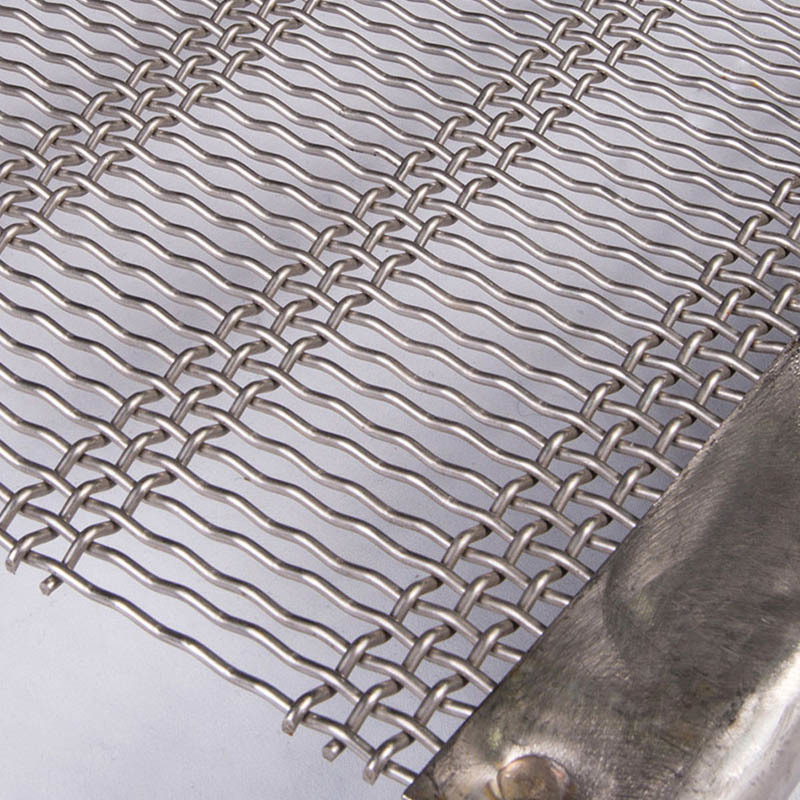
The primary innovation in anti blocking screen mesh is controlled secondary motion. In a wave-wire or crimped-wire design, individual wires flex at the crossover points as the vibrating screen deck accelerates and decelerates. This micro-vibration creates a continuous "opening and closing" pulse at each aperture — effectively ejecting any particle that attempts to wedge. Real-world testing on aggregate screening lines has confirmed that this secondary flex can increase open area utilisation by 15–30% compared to rigid standard mesh under identical feed conditions.
Polyurethane screen panels achieve a similar result through bulk elasticity. The entire panel deforms and rebounds with each vibration cycle, and the slot geometry is moulded to a slight taper — wider at the bottom — so that particles passing through accelerate rather than jam. This taper-aperture principle is also applied in certain perforated metal screen variants, though the elastic component is absent.
Key product families that fall under this category
Several distinct product types qualify as anti blocking screen mesh in current industrial use:
- Wave-wire self-cleaning screen mesh (Type D and Type E profiles) — crimped woven wire with elevated crossover points
- Piano-wire / harp screen — parallel tensioned wires without transverse weaving, allowing independent lateral movement
- Polyurethane screen panel — cast or injection-moulded elastic slotted panels
- Flip-flow elastic screen — alternating fixed and floating rows that stretch and snap, generating high-G local acceleration
- Perforated metal screen with profiled holes — tapered or slotted apertures in stainless steel filter mesh or mild steel plate
Each family suits a different feed type, moisture level, and required cut size, a point explored in detail in the selection section below.
How standard mesh works — and where it fails
Standard woven wire mesh screen is constructed by weaving crimped or straight wires in an over-under pattern at right angles, producing a fixed square or rectangular aperture at each intersection. The geometry is rigid: once woven, the aperture size does not change during operation. This rigidity is an asset for dry, free-flowing materials with low clay content — it delivers consistent cut size and predictable open area.
The failure mode becomes apparent the moment feed conditions deviate from ideal. Why do so many operations in Punjab and Khyber Pakhtunkhwa experience mesh blinding during the monsoon months? The answer lies in what engineers call the "near-size fraction" problem. Particles whose diameter is between 70% and 100% of the nominal aperture size are statistically the most likely to lodge. In a rigid woven wire mesh screen, those particles have no mechanism to dislodge themselves; they simply accumulate until the effective open area collapses and throughput drops sharply.
Moisture and clay: the two primary blinding triggers
Moisture acts as a binder. Even 4–6% surface moisture on a crushed limestone feed can cause fine particles to agglomerate and coat wire surfaces, reducing the effective aperture diameter. In the Thar coalfields, run-of-mine lignite routinely carries 30–45% inherent moisture, making standard industrial sieve mesh essentially non-functional without pre-drying or screen heating — both operationally costly approaches.
Clay minerals (primarily smectite and illite found in alluvial deposits across the Indus plain) are worse still. They form a thin, tenacious film on wire surfaces that standard stainless steel filter mesh cannot shed passively. The result is progressive blinding: throughput drops 20% in the first hour, 40% by the third, and the screen is effectively dead within a shift.
Abrasion: the secondary limitation
High-silica feeds — quartzite, granite chips (chips used in road construction), and certain river gravels — erode wire diameters at the crossover points. Standard woven wire mesh screen loses cross-sectional area progressively at these high-stress nodes, increasing aperture size unpredictably and degrading product gradation well before physical mesh failure. The mesh may look intact while already producing out-of-spec bajri.

Structural differences: wire geometry, aperture design, and panel materials
The most reliable way to understand why anti blocking screen mesh outperforms standard mesh is to compare their structures side by side. The table below summarises the principal differences across five design parameters.
| Parameter | Anti blocking screen mesh | Standard woven wire mesh |
|---|---|---|
| Wire profile | Wave/crimp, D-shape, trapezoidal | Round, straight or lightly crimped |
| Aperture geometry | Tapered, slotted, or dynamically variable | Fixed square or rectangle |
| Secondary motion | Yes — elastic flex or panel bounce | None — rigid structure |
| Typical panel material | Mn steel, stainless steel, polyurethane | Low-carbon or stainless steel wire |
| Open area (%) | 30–45% (maintained under load) | 40–55% (theoretical, reduces quickly) |
| Blinding resistance | High — active self-cleaning | Low — passive, prone to blinding |
| Typical service life (abrasive feed) | 3–6 months (Mn steel variant) | 4–8 weeks |
Wire profile and crossover design in depth
The trapezoidal or D-shaped wire profile used in high-end anti blocking screen mesh serves a dual purpose. First, the flat inner face of the aperture provides a larger particle-contact surface compared to round wire, which reduces the contact-stress concentration that causes wire wear. Second, the angled outer face sheds moisture and fine particles by gravity between vibration cycles — functioning, in effect, like a microscopic drainage channel on each wire.
Compare this to standard round wire, where the curved surface actually cradles fine particles in the groove between adjacent wires at the crossover. Under dry conditions this is inconsequential. Under the wet feed typical of a Punjab quarry after a monsoon shower, it becomes the primary blinding initiation point.
Polyurethane screen panels vs woven wire: a material perspective
Polyurethane screen panels represent a different engineering philosophy altogether. Rather than optimising wire geometry, they eliminate wire entirely. The elastic modulus of polyurethane (typically 10–50 MPa shore hardness range for screening applications) allows the entire panel to deform by 2–5 mm per vibration cycle. This bulk deformation continuously changes the stress state at the aperture walls, preventing adhesion bonds from forming. The result is a genuinely non-blinding screen panel for materials up to roughly 80 mm nominal size.
The trade-off is open area. A polyurethane screen panel typically delivers 25–38% open area versus 40–55% for an equivalent woven wire mesh screen. For high-volume, dry applications, this difference in throughput capacity matters significantly. That said, an anti-clogging filter screen operating at 35% effective open area consistently outperforms a standard mesh nominally rated at 50% open area but blinding to 15–20% effective open area within the first hour of a wet shift.
Performance comparison: screening efficiency, blinding resistance, and service life
Performance data from vibrating screen operations in aggregate and mining contexts reveal consistent patterns. Anti blocking screen mesh maintains higher effective screening efficiency over time, particularly under non-ideal feed conditions. Standard mesh delivers better initial throughput in dry conditions but degrades rapidly when moisture or clay content rises.
"In wet screening applications, non-blinding screen panel technology can recover 20–35% of lost throughput compared to conventional woven mesh, with the greatest gains observed in feeds with greater than 8% surface moisture and significant near-size fraction." — Metso Screening Technology Reference Manual, 2024 edition
Screening efficiency over a full production shift
Actual testing on a 2-deck vibrating screen processing crushed limestone (feed moisture 10–12%, 20 mm nominal aperture) demonstrated the following pattern. Standard woven wire mesh screen started at 91% screening efficiency but declined to 68% by hour 4 as blinding progressed. Anti blocking screen mesh (wave-wire type) started at 87% — slightly lower due to reduced open area — but held at 83% through hour 8 with no manual intervention. Net tonnage over the full shift favoured the anti blocking variant by approximately 18%.
High frequency screen mesh variants, which operate at 1,800–3,600 RPM rather than the conventional 700–1,000 RPM range, amplify this advantage further. The increased G-force (up to 6–8 G versus 3–4 G for standard vibrating screens) combined with self-cleaning wire geometry produces effective separation of fine particles down to 0.5 mm in difficult, cohesive feeds — a performance range that standard mesh simply cannot achieve reliably.
Service life: the economics of less frequent replacement
Service life comparisons depend heavily on feed abrasivity. In a typical Pakistani road-metal quarry processing hard dolerite, standard woven wire mesh screen in a 12 mm aperture requires replacement every 3–5 weeks. A manganese steel wave-wire anti blocking screen mesh of equivalent aperture lasts 10–18 weeks on the same deck. That reduction in changeout frequency translates directly to fewer hours of downtime per month — a significant operational advantage given that spare parts logistics in many parts of Pakistan involve 3–10 day lead times from major supply centres.
Of course, there are situations where standard mesh remains the pragmatic choice. For dry sand classifications below 2 mm, or for applications where feed is genuinely non-cohesive and abrasivity is low, the additional engineering of anti blocking screen mesh may not justify the incremental consideration. Honest assessment of feed conditions matters more than blanket product substitution.
Application scenarios: when to choose anti blocking over standard mesh
Anti blocking screen mesh is not universally superior — it is specifically superior in a defined set of conditions. Understanding those conditions prevents both over-specification and under-performance.
Mining and coal preparation in Pakistan
Pakistan's coal preparation plants, particularly those processing Balochistan and Thar basin lignite, face extreme blinding challenges. Run-of-mine coal with 25–45% moisture content, combined with a high clay-mineral gangue fraction, renders standard mesh screens inoperable without mechanical cleaning in under 30 minutes. Mining screen mesh Pakistan suppliers have increasingly moved toward flip-flow elastic screen and polyurethane screen panel configurations for primary desliming stages, with wave-wire anti blocking screen mesh on secondary sizing decks.
The Reko Diq copper-gold project (expected to reach full processing capacity around 2028) and ongoing expansion of Saindak operations are creating substantial demand for high-performance screening media. Mineral processing engineers working on these projects consistently specify self-cleaning screen mesh for SAG mill trommel screens and tailings classification stages, citing moisture from wet grinding circuits as the primary blinding driver.
Aggregate and construction materials
Pakistan's cement sector shipped approximately 46 million tonnes in fiscal year 2025, with FY26 domestic sales projected to grow 7.2% according to APCMA data. That growth drives proportional demand in aggregate crushing and screening. Over 650 aggregate quarries in Punjab alone (based on commerce ministry preliminary assessment data) process materials ranging from river gravel — which carries significant clay contamination from the Indus flood plain — to hard crushed granite and limestone chips.
For aggregate producers supplying NHA (National Highway Authority) road construction projects, product gradation compliance is non-negotiable. This is exactly the scenario where anti blocking screen mesh earns its keep: it maintains accurate cut size throughout a wet shift without the gradation drift that blinded standard mesh causes.
Agriculture and grain processing applications
Mesh screen for agriculture uses — specifically grain cleaning, paddy de-stoning, and cottonseed pre-cleaning — presents a different challenge. The abrasivity is low, but sticky husks, immature grains, and high harvest-season moisture create blinding on fine mesh strainer screen surfaces rapidly. Here, light-gauge wave-wire self-cleaning screen mesh in stainless steel filter mesh construction offers the best balance: food-grade surface finish, anti-clogging aperture geometry, and sufficient corrosion resistance for humid post-harvest environments.
Dust filter screen mesh for industrial ventilation and dust suppression systems represents yet another context. Wet-method dust suppression — increasingly adopted as environmental awareness rises in Pakistan's industrial zones — intentionally introduces moisture. Any dust filter screen mesh in this application must be specified as non-blinding by design, or filter maintenance cycles become unworkably short.
How to select the right anti blocking screen mesh for your operation
Selecting the correct anti blocking screen mesh requires a structured assessment of four feed parameters and three operational constraints. Following the steps below prevents the common mistake of choosing a product based on aperture size alone.
- Characterise the feed. Measure or estimate: (a) top size and nominal aperture required, (b) near-size fraction as a percentage of total feed, (c) surface moisture content, (d) clay mineral content (a simple wet-sieve vs dry-sieve comparison gives an approximate indicator).
- Assess abrasivity. Use the Bond Abrasion Index if available, or categorise feed as low (limestone, soft coal), medium (dolerite, quartzite), or high (flint, magnetite ore). High abrasivity favours manganese steel or stainless steel wave-wire anti blocking screen mesh over polyurethane panels for coarse fractions.
- Determine the aperture range. For apertures above 50 mm, polyurethane screen panel or perforated metal screen with profiled apertures is standard. For 5–50 mm, wave-wire woven wire mesh screen or harp screen. For sub-5 mm with high moisture, high frequency screen mesh with anti-clogging aperture geometry.
- Evaluate vibration parameters. Confirm that the existing vibrating screen can accommodate the panel type — polyurethane screen panels require specific deck support systems. Flip-flow screens require dedicated machine frames and cannot retrofit to conventional circular-motion vibrating screens.
- Define the maintenance constraint. If screen changeout requires more than 4 hours due to access or remote location, bias toward longer-life options (manganese steel wave-wire or polyurethane panels). If changeout is fast and feed is variable, modular bolt-in panels offer operational flexibility.
- Pilot test where possible. Run a 30-day comparative trial with one deck on anti blocking screen mesh and one on standard mesh under identical feed conditions. Record effective open area readings at the start of each shift. The data from this trial will confirm the selection more reliably than any specification sheet.
Matching mesh type to specific screening stages
Primary scalping (removing oversize above 100 mm) is typically done on grizzly bars or perforated metal screen — anti blocking features matter less here because the aperture is large relative to near-size particles. Secondary and tertiary sizing stages, particularly those making product cuts in the 5–40 mm range, are where anti blocking screen mesh delivers the most measurable benefit. Final dewatering and classification stages in washing plants, where feed can be a slurry, almost universally require non-blinding screen panel technology.
Stainless steel vs polyurethane: a material decision guide
Stainless steel filter mesh in an anti blocking wave-wire configuration offers superior thermal resistance (relevant for hot process streams), precise aperture tolerance (critical for fine sizing), and compatibility with standard tensioning systems on existing vibrating screens. Its limitation is fatigue life under high-frequency operation — wires eventually work-harden and fracture at crossover points after repeated flex cycles.
Polyurethane screen panel construction absorbs impact better, is quieter in operation (a meaningful consideration in noise-sensitive plant environments), and resists corrosion in acidic or saline wash water. The practical limitation is temperature sensitivity: polyurethane panels soften above 60°C, which matters in drying circuits, and they are not suitable as fine mesh strainer screen below approximately 1 mm aperture because manufacturing tolerances become unacceptable at that scale.
Common misconceptions about anti blocking screen mesh
Several persistent misconceptions cause operators to either reject anti blocking screen mesh unnecessarily or to adopt it without understanding its limits. Addressing these directly serves both accuracy and informed decision-making.
Misconception 1: simply enlarging the aperture solves blinding
This is perhaps the most damaging misconception in aggregate screening practice. Increasing aperture size does reduce the probability of near-size wedging in the short term, but it simultaneously allows oversize material to pass, destroying product gradation. For NHA road construction specifications, crushed aggregate must meet strict grading envelopes. An operator who opens up a 20 mm deck to 25 mm to avoid blinding will likely fail the sieve analysis at the first batch test — and face rejection of an entire stockpile. Anti blocking screen mesh resolves the blinding problem at the specified aperture size, without compromising gradation compliance.
Misconception 2: anti blocking mesh is only for heavy mining applications
The term "anti blocking" in some markets is associated primarily with high-tonnage mining screen mesh — heavy-duty, coarse-aperture panels for iron ore or coal. This association causes smaller operations (aggregate producers, grain processors, municipal waste screeners) to overlook lighter-duty variants designed precisely for their application range. Lightweight wave-wire self-cleaning screen mesh in apertures as small as 0.5 mm is commercially available and directly applicable to grain cleaning and fine aggregate classification.
Misconception 3: confusing industrial screening mesh with domestic window mesh
Search analytics from Pakistan show a notable volume of queries mixing "anti blocking screen mesh" with fiberglass or aluminium window insect screens. These are entirely different product categories with no functional overlap. Industrial anti blocking screen mesh operates under dynamic load on vibrating machinery; domestic insect screen mesh is a static barrier. Procurement teams sourcing industrial screening media should verify that supplier catalogues specifically reference vibrating screen applications, aperture tolerances in millimetres, and wire diameter specifications — none of which appear in domestic mesh product data.
Misconception 4: anti blocking screen mesh requires no maintenance at all
The term "self-cleaning" is accurate but should not be interpreted as "maintenance-free." Even the most effective non-blinding screen panel benefits from periodic inspection of wire tension (for harp screens), panel fastening integrity, and aperture wear measurement. In highly abrasive applications, wear at the aperture edges will eventually enlarge the nominal size beyond product specification tolerances, regardless of the anti-blinding mechanism. A recommended inspection interval of every 200–300 operating hours is consistent with best-practice maintenance schedules documented in vibrating screen OEM manuals.
Conclusion
The difference between anti blocking screen mesh and standard mesh is not simply a matter of product grade — it reflects two different engineering responses to the fundamental challenge of maintaining aperture integrity under real-world feed conditions. Standard woven wire mesh screen remains entirely appropriate for dry, free-flowing, low-clay feeds where blinding risk is genuinely low. But for the majority of Pakistani aggregate, mining, and processing operations — where monsoon moisture, high-clay alluvial feeds, and high-silica abrasive materials are routine — the operational case for anti blocking screen mesh is well-supported by both performance data and field experience.
Selecting the right variant — wave-wire, polyurethane screen panel, harp screen, or high frequency screen mesh — requires systematic feed characterisation rather than a blanket specification. The six-step selection process outlined above provides a practical framework. Operators who pilot-test before full conversion consistently report better outcomes than those who switch entire fleets based on specification sheets alone. When properly matched to the application, anti blocking screen mesh reduces unplanned downtime, maintains product gradation compliance, and extends screening media service life — a combination that justifies its specification in any demanding screening environment.
Frequently asked questions
Q: What is the main difference between anti blocking screen mesh and standard woven wire mesh?
A: Anti blocking screen mesh incorporates elastic wire profiles, tapered apertures, or bulk-elastic panel materials that actively dislodge near-size particles during operation. Standard woven wire mesh uses a fixed rigid aperture that provides no self-cleaning action, making it prone to blinding when feed contains moisture, clay, or a high near-size fraction.
Q: Can anti blocking screen mesh be fitted to existing vibrating screens?
A: Wave-wire and harp-screen variants can typically retrofit to standard tensioning systems on most vibrating screen decks. Polyurethane screen panels require compatible deck support rails. Flip-flow screens require a dedicated machine frame and are not retrofit-compatible with circular-motion vibrating screens. Always verify deck compatibility with the panel supplier before ordering.
Q: Is polyurethane screen panel better than stainless steel anti blocking mesh?
A: Neither is universally superior. Polyurethane screen panels excel in wet, corrosive, or impact-heavy applications and are quieter in operation. Stainless steel filter mesh in a wave-wire anti blocking configuration offers tighter aperture tolerance, higher temperature resistance, and suitability for sub-1 mm fine separation. The correct choice depends on feed abrasivity, moisture level, aperture size, and operating temperature.
Q: How often should anti blocking screen mesh be inspected or replaced?
A: Inspection every 200–300 operating hours is a widely accepted benchmark. Replacement is triggered when measured aperture dimensions exceed the specified tolerance by more than 10–15%, or when wire diameter loss at crossover points exceeds 20% of original. Visual inspection alone is insufficient; physical aperture measurement with calibrated gauges is recommended for product-critical screening stages.
Q: Which type of anti blocking screen mesh is most suitable for coal screening in Pakistan?
A: For high-moisture lignite from Thar or Balochistan coal basins, flip-flow elastic screens or polyurethane screen panels on primary desliming stages are most effective. Secondary sizing of washed coal with 10–20% residual moisture typically suits wave-wire self-cleaning screen mesh in manganese steel. High frequency screen mesh is used for fine coal dewatering below 1 mm aperture.
Key words:
RELATED INFORMATION

How to clean and maintain stainless steel screen to extend its lifespan
2026-11-16
Anti blocking screen mesh vs standard mesh: key differences explained
2026-11-16
Anti-clogging screen mesh buyer's guide: types, materials & applications
2026-11-16
PRODUCT SEARCH
Quickly find the products you need
Surpass Oneself, Pursue Advanced
PRODUCT SOLUTION
To provide you with industry solutions
Please leave the information you want to consult


Service E-mail
Service TEL
Address
Hengshui HeBei China
Our Main Products
Powerby:300.cn | Label | Privacy Policy