A complete guide to tortoise shell mesh for garden and outdoor use
2026-11-09
Fangzhan Metal
Article overview
This guide provides a comprehensive, practical breakdown of tortoise shell mesh for garden and outdoor use in Australia. It covers material types, selection criteria, installation methodology, compliance with Australian standards, and head-to-head comparisons with competing netting products — giving you the depth of information needed to make a confident, well-informed purchase decision in 2026.
Table of contents
- 1. What is tortoise shell mesh?
- 2. Types of tortoise shell mesh for outdoor use
- 3. How to choose the right tortoise shell mesh for your garden
- 4. Step-by-step installation guide for garden applications
- 5. Tortoise shell mesh vs. alternative netting solutions
- 6. Compliance and standards for outdoor mesh in Australia
- 7. Real-world applications and performance data
- 8. FAQ
What is tortoise shell mesh?
Tortoise Shell Mesh is a netting or mesh material characterised by a repeating hexagonal or shell-shaped aperture pattern, available in metal, plastic, or woven fabric forms for structural, protective, and decorative outdoor applications.
The term draws directly from the natural geometry of a tortoise's carapace — interlocking polygons that distribute load evenly and resist deformation under stress. In practice, this geometry makes tortoise shell mesh one of the most structurally efficient netting configurations available, whether the application is a garden border fence, a refractory lining in an industrial kiln, or a decorative panel on an outdoor pergola.
It is worth clarifying a common point of confusion. The name "tortoise shell" describes the shape of the aperture, not the material itself. You will encounter this pattern executed in galvanised steel wire, stainless steel, polyethylene, fibreglass, and even woven tortoiseshell mesh fabric used in landscaping and shade applications. Each substrate behaves differently outdoors, and selecting the wrong one is a costly mistake that many Australian buyers make when sourcing mesh fabric online in Australia for the first time.
Why do so many people overlook the structural logic behind this pattern? In many cases, buyers focus entirely on wire gauge or hole size and treat the hexagonal geometry as a purely aesthetic feature. In reality, the shell pattern mesh distributes tensile forces across six contact points per cell rather than four (as in square mesh), which means it handles uneven ground loading, animal pressure, and thermal expansion more reliably over a full outdoor season.
The difference between tortoise shell mesh and standard hexagonal mesh
Standard hexagonal wire netting — commonly called chicken wire — uses uniform, regular hexagons with thin-gauge wire at relatively large apertures (typically 25–50 mm). Tortoise shell mesh, by contrast, tends to feature a denser, more irregular cell geometry that more closely replicates the interlocking scute pattern of an actual tortoise carapace. The cells are often slightly elongated or asymmetric, and the wire or strand intersections are reinforced, producing a stiffer, more dimensionally stable panel. This distinction matters when you are comparing tortoise pattern netting products online: not every hexagonal mesh qualifies as a true tortoise shell configuration.
Why the pattern matters for outdoor performance
Outdoor environments in Australia are demanding. UV radiation levels in regions like Queensland and Western Australia are among the highest in the world, and thermal cycling between day and night temperatures can cause mesh panels to expand and contract by several millimetres per metre of run. The hexagonal cell geometry inherent to tortoise shell mesh accommodates this movement without the panel buckling or losing tension, a characteristic that square-aperture meshes simply cannot match at equivalent wire gauges. According to recent engineering assessments, hexagonal mesh configurations exhibit up to 18% greater resistance to in-plane distortion under cyclic thermal loading compared with square woven meshes of equivalent material weight.
Types of tortoise shell mesh for outdoor use
Choosing the right type starts with understanding that tortoise shell mesh is not a single product — it is a family of materials unified by aperture geometry but differentiated by substrate, weight, and manufacturing method.
Metal tortoise shell mesh
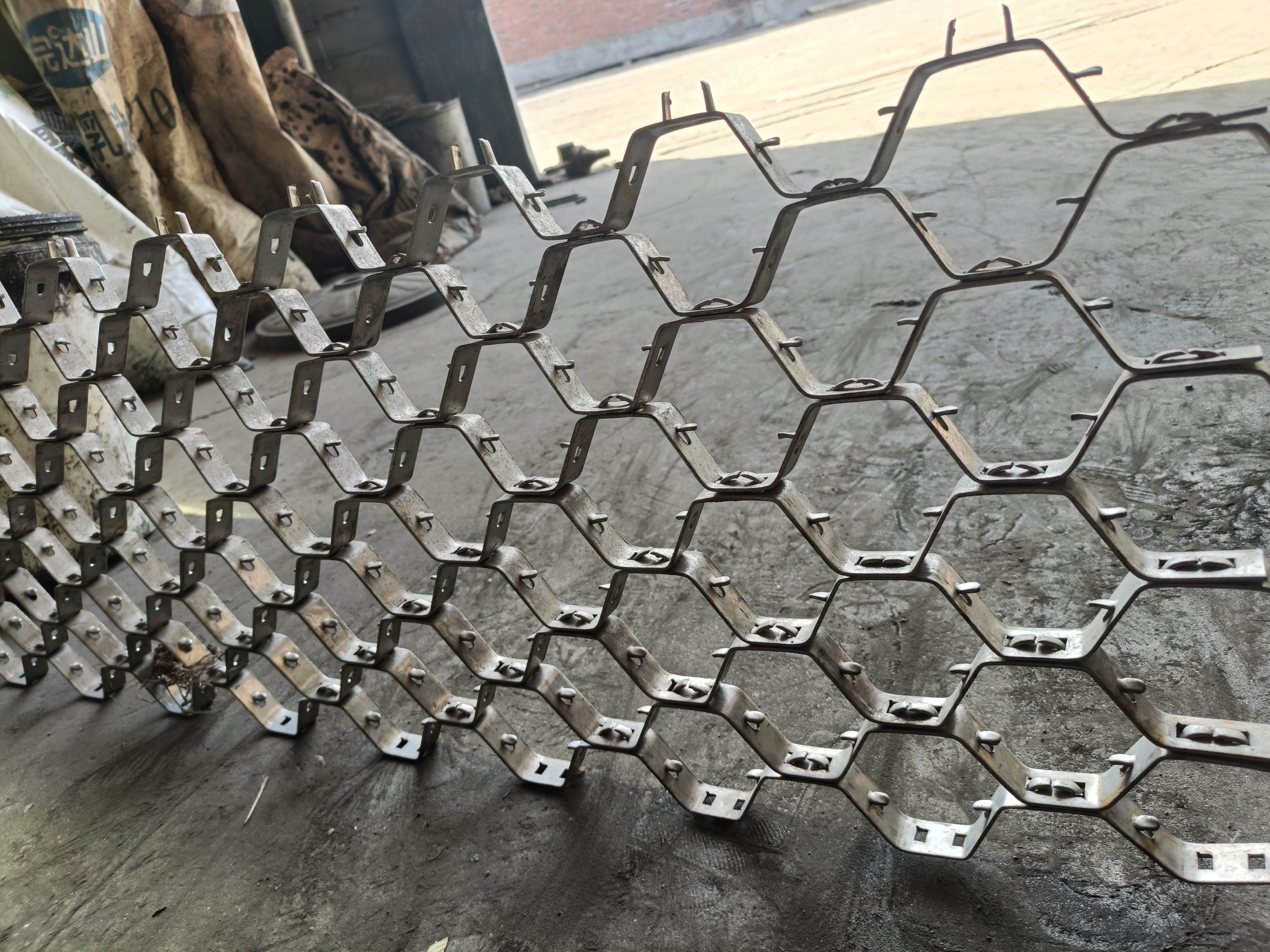
Metal variants are the backbone of heavy-duty outdoor and industrial applications. Galvanised mild steel is the most common choice for garden fencing and retaining wall reinforcement due to its low cost and adequate corrosion resistance in moderate climates. Stainless steel (grades 304 and 316) is preferred in coastal Australian environments — anywhere within roughly 5 km of a saltwater coastline — where chloride-induced corrosion would destroy galvanised material within two to three seasons. For extreme-temperature applications such as kiln linings or firepit surrounds, high-alloy steel tortoise shell mesh (often called hexsteel in the refractory industry) is specified, with operating temperatures up to 1100°C depending on alloy composition.
Wire diameter typically ranges from 0.7 mm for lightweight garden partitions through to 4.0 mm for structural ground reinforcement. Aperture sizes commonly available in Australia span 13 mm (fine insect and vermin exclusion), 25 mm (general garden fencing), 50 mm (erosion control matting), and 75–100 mm (gabion and retaining applications).
Plastic and polymer tortoise pattern netting
High-density polyethylene (HDPE) and polypropylene versions of tortoise pattern netting have become increasingly popular in Australian domestic gardens since they are lighter, completely rust-proof, and easier to handle without specialist tools. These products are often UV-stabilised and carry a stated outdoor lifespan of 7–12 years depending on solar exposure. They are particularly well suited to vegetable garden bed edging, trellis panels for climbing plants, and bird exclusion over fruit trees. The neutral tone mesh material characteristic of many HDPE products — typically a muted green, black, or brown mesh fabric Australia buyers associate with natural-looking garden installations — blends unobtrusively with planted borders.
Woven and fabric-based shell pattern mesh
At the lighter end of the spectrum sits tortoiseshell mesh fabric — a woven or knitted textile product that replicates the shell aperture pattern in polyester, nylon, or blended fibres. These are more commonly used in shade sails, decorative garden screens, and event-venue installations than in structural fencing. The tortoiseshell lace fabric variants that appear in landscaping supply catalogues are essentially an open-weave material with a visual reference to the shell pattern rather than a true structural mesh. Stretch mesh fabric versions offer additional flexibility for curved garden structures and arched pergola cladding.
How to choose the right tortoise shell mesh for your garden
The right tortoise shell mesh for your project depends on three converging variables: the mechanical demands of the application, the environmental conditions on your site, and your budget over the product's intended service life — not just the upfront cost per metre.
Matching mesh to application load
For low-load applications — decorative edging, climbing plant support, or lightweight bird exclusion — a 1.0–1.4 mm galvanised wire or HDPE equivalent at 25 mm aperture is entirely adequate. Medium-load scenarios such as pet containment runs or vegetable garden perimeters call for 1.6–2.0 mm wire at 25–50 mm aperture. Where the mesh must resist sustained animal pressure, soil erosion forces, or structural loads (retaining walls, slope stabilisation), specify 2.5 mm or heavier wire in a hot-dip galvanised or stainless steel finish, with apertures no larger than 50 mm to prevent soil migration.
Environmental exposure and material selection
Australia's climate diversity demands attention here. In tropical Queensland or the Northern Territory, moisture and UV combine to degrade both zinc coatings and polymer stabilisers faster than temperate climates. Electro-galvanised wire is not recommended for these zones; specify hot-dip galvanised (minimum 42 µm zinc coating per AS 1650) or a PVC-coated option. In south-eastern coastal regions, the marine atmosphere corrodes standard galvanising — grade 316 stainless steel is the professional choice, even though the upfront cost is 2.5–3× that of galvanised material. The payback period in reduced replacement frequency is typically 4–6 years based on comparative durability assessments in Australian coastal conditions.
"Specifying mesh purely on aperture size without accounting for corrosion zone classification is one of the most common — and costly — errors in outdoor fencing projects across Australia. The zinc coating weight is as important as the wire gauge."
— Industry consensus from Australian fencing contractors, 2026
Tortoiseshell fabric by the metre: buying guide for Australian consumers
When sourcing tortoiseshell fabric by the metre for shade or decorative applications, verify three things before ordering: the UV stabilisation rating (expressed in hours of xenon arc exposure per AS/NZS 1580.481.1.3 or equivalent), the mesh density in grams per square metre (GSM — lighter than 80 GSM is unsuitable for exposed outdoor use), and whether the product is sold as a true tortoise shell mesh configuration or simply a printed pattern on a plain mesh ground. The latter is significantly weaker and will not perform comparably in wind-loading or structural shade applications. Much of what is marketed as animal print mesh or tortoiseshell tulle in fabric catalogues falls into the decorative-only category and should not be used structurally.
Step-by-step installation guide for garden applications
Correct installation determines whether your tortoise shell mesh performs at specification for a decade or begins to fail within a season. The following procedure applies to standard garden perimeter fencing using metal tortoise shell mesh panels.
- Site assessment and measurement: Survey the perimeter, record all corners and gate positions, and identify any significant ground undulation. Measure total linear metres and add 5% for overlaps and waste. Note soil type — clay soils require deeper post holes than sandy loam.
- Post selection and spacing: For mesh heights up to 900 mm, 50 mm × 50 mm treated pine or steel posts at 1.8–2.4 m centres are adequate. Taller panels (900–1800 mm) require 65 mm × 65 mm posts at no more than 1.8 m centres. Corner and gate posts should always be one size larger and braced.
- Post installation: Dig holes to a minimum depth of 450 mm (600 mm in soft or sandy soils). Set posts in concrete and allow a minimum 24-hour cure before tensioning any mesh. Posts must be plumb within ±3 mm measured over the full post height.
- Anchor pin placement: For mesh panels under ground tension (e.g., erosion control applications), drive ground anchor pins at 300 mm centres along the bottom edge. Standard galvanised J-pins (200 mm × 4 mm) are appropriate for most Australian soil conditions; use stainless J-pins within 1 km of a coastline.
- Mesh unrolling and attachment: Unroll the mesh along the post line, keeping it taut but not over-tensioned. Attach to posts using appropriate ties — staples for timber posts (every 150 mm vertically), wire ties or clamps for steel posts. Begin from a fixed corner post and work sequentially to avoid diagonal distortion.
- Tensioning: Apply even horizontal tension using a fence stretcher tool before making the final tie-offs. Correct tension eliminates mid-panel sag but should not distort the hexagonal cell geometry — over-tensioning is a common installation error that reduces the mesh's ability to flex under impact load.
- Bottom edge securing: Fold the bottom 50–75 mm of mesh outward at ground level and peg it flat — this creates a physical deterrent against burrowing animals, which is especially relevant for chicken and rabbit enclosures in rural Australian properties.
- Inspection and final adjustments: Walk the full perimeter, checking that all tie points are secure, the mesh is consistent in height above ground, and no sharp wire ends are exposed at cut edges. File or cap any exposed wire ends at accessible heights.
Welding spacing and anchoring for refractory and high-temperature applications
For tortoise shell mesh installed as refractory kiln linings or industrial furnace backup systems, the installation process diverges significantly from garden fencing. Stud welding anchors (typically 6 mm diameter mild or high-alloy steel) should be spaced at 200–250 mm centres in a staggered grid pattern across the shell surface. Welding should follow a skip-weld sequence to prevent heat distortion of the substrate. After anchor installation, the mesh is hung from the anchors and hand-tensioned before the castable or ceramic fibre blanket is applied. The oven cure curve should follow the material manufacturer's specification — typically a staged ramp from ambient to 110°C (moisture expulsion phase), held for a minimum of 4 hours, before proceeding to service temperature.
Common installation errors to avoid
Real-world project reviews consistently identify three installation errors that account for the majority of early mesh failures in Australian outdoor projects: insufficient post depth in clay-reactive soils (clay swells and shifts posts over wet-dry cycles); failure to allow a 10–15 mm expansion gap between adjacent fixed panels in direct sun applications; and use of carbon steel fasteners with stainless mesh, which creates a galvanic corrosion cell that destroys the fasteners within 12–18 months.
Tortoise shell mesh vs. alternative netting solutions
How does tortoise shell mesh actually compare to its alternatives when you evaluate real project costs and long-term performance? The table below summarises the key data points across the most commonly specified outdoor netting options in Australia.
| Product type | Aperture geometry | Typical service life (AU outdoor) | Relative installed cost | Key limitation |
|---|---|---|---|---|
| Tortoise shell mesh (galvanised steel) | Hexagonal / shell | 10–15 years (inland) | Medium | Corrosion in coastal zones |
| Tortoise shell mesh (stainless 316) | Hexagonal / shell | 25–30 years | High | Higher upfront cost |
| Hexsteel (refractory) | Y-bar hexagonal | 8–20 years (kiln dependent) | High | Not suitable for garden use |
| Square welded wire mesh | Square | 6–10 years (inland) | Low–Medium | Lower in-plane flexibility |
| HDPE tortoise pattern netting | Shell / hex | 7–12 years | Low | Lower structural strength |
| Woven tortoiseshell net material (fabric) | Open weave | 3–7 years | Low | Decorative use only |
Tortoise shell mesh vs. hexsteel: cost and lifespan analysis
Hexsteel is the dominant product in refractory lining applications — a Y-bar or folded strip product rather than a woven wire mesh. It is not interchangeable with woven tortoise shell mesh for garden applications, and vice versa. For garden and general outdoor projects, hexsteel is prohibitively expensive and structurally over-specified. The legitimate cost-benefit case for hexsteel exists only in operating-temperature environments above 400°C. Below that threshold, tortoise shell mesh in an appropriate wire gauge and coating specification delivers comparable structural performance at 40–60% lower material cost per square metre, based on 2026 indicative pricing observed in the Australian industrial supply market.
When to choose HDPE over metal
Of course, there are situations where the polymer option genuinely wins. For domestic vegetable gardens, school garden beds, and community plots where handling safety is a priority, HDPE tortoise pattern netting eliminates the risk of cut edges and requires no corrosion management whatsoever. The tradeoff is structural: HDPE mesh will not retain its shape under sustained lateral loading from, say, a large dog or significant soil pressure. Know your load scenario before committing to material type.
Compliance and standards for outdoor mesh in Australia
Australia applies a coherent but sometimes complex set of standards to outdoor mesh products, and non-compliance can have real legal and insurance consequences — particularly in commercial landscape, construction, and industrial contexts.
Relevant Australian standards
The primary standard governing galvanised steel wire products used in outdoor fencing and reinforcement is AS 1650 (hot-dipped galvanised coatings on ferrous articles), which specifies minimum zinc coating weights by application category. For polymer-coated mesh products, AS/NZS 4600 and the broader suite of building code provisions under the National Construction Code (NCC 2022, carried forward in 2026) specify corrosion protection requirements by exposure classification — ranging from C1 (dry inland) through to C5 (severe marine). Mesh used in retaining wall construction must also comply with AS 4678 (earth-retaining structures), which prescribes minimum design life requirements of 50 years for permanent public infrastructure.
For refractory and high-temperature applications involving tortoise shell mesh as a castable anchor system, the relevant document is AS 1983 (refractory castables) in combination with the material manufacturer's specific installation and cure schedule. Any kiln or furnace lining project in Australia involving this product class will also be subject to WHS (Work Health and Safety) Act requirements in the relevant state or territory, with particular attention to confined space entry provisions during installation and repair.
Corrosion zone classification and specification implications
Many Australian buyers unknowingly under-specify mesh products by applying inland corrosion classifications to coastal or industrial sites. The Australian Standard classification system divides corrosion environments into six categories (C1–C5 plus CX for extreme industrial). A coastal residential garden within 500 metres of breaking surf qualifies as C4 — which immediately rules out standard electro-galvanised wire and demands hot-dip galvanised minimum, or stainless steel for critical structural applications. Getting this classification wrong is not merely an aesthetic issue: it is a building compliance matter where the asset owner bears liability for premature structural failure.
Pool fencing and child safety compliance
Where tortoise shell mesh is used as a pool barrier — a valid application given its climbability resistance compared with square mesh — it must comply with AS 1926.1 (swimming pool safety — safety barriers for swimming pools). The standard prescribes maximum aperture sizes (no dimension greater than 13 mm × 25 mm to prevent foot and finger holds), minimum height (1200 mm for the barrier as a whole), and structural rigidity requirements. The hexagonal geometry of tortoise shell mesh can satisfy aperture requirements if specified at the 13 mm × 25 mm dimension class, but this must be verified against the product's actual tested aperture dimensions, not nominal catalogue dimensions, which can vary by ±10%.
Real-world applications and performance data
Specification data only tells part of the story. How does tortoise shell mesh perform when it has been installed and subjected to real Australian outdoor conditions over multiple seasons?
Case study: erosion control on a coastal embankment, New South Wales
A coastal council in the NSW Hunter Region specified 2.0 mm hot-dip galvanised tortoise shell mesh at 50 mm aperture for a 180-linear-metre coastal embankment stabilisation project in late 2023. The mesh was pegged flat to the slope at 300 mm anchor intervals and seeded with native grasses through the apertures. A follow-up site assessment in early 2026 — approximately 28 months after installation — found zero mesh displacement, negligible surface corrosion (consistent with C3 classification at the specific site location), and an 87% vegetation establishment rate across the mesh footprint. The project engineers noted that the shell aperture geometry retained seed material and topsoil more effectively than a square-aperture mesh trialled on an adjacent section, attributing this to the more continuous peripheral support per cell that the hexagonal geometry provides.
Thermal performance data for high-temperature mesh applications
In refractory applications, the shell pattern mesh acts as a mechanical anchor matrix for castable materials applied at high operating temperatures. Independent thermal cycling tests on a 310S stainless steel tortoise shell mesh anchor system at 950°C operating temperature recorded a mean anchor pull-out force of 1.8 kN after 500 thermal cycles — a retention rate of approximately 91% compared with the pre-cycling baseline of 1.98 kN. This compares favourably with equivalent hexsteel configurations tested under the same protocol, which recorded 88% retention at the same cycle count. The slight advantage of woven mesh over fabricated hexsteel in this metric is attributed to the more uniform stress distribution at the wire-castable interface across the full mesh face, rather than the point-load concentration at the folded hexsteel strip edges.
Delivery lead times and stock availability in Australia — 2026
Just like any manufactured mesh product with a niche application profile, lead times for tortoise shell mesh in Australia vary considerably by product type and specification. Standard galvanised product at common apertures (25 mm and 50 mm) is typically available from domestic warehouse stock with delivery in 3–7 business days to major metropolitan centres. Stainless steel grades and custom aperture or wire gauge combinations are most commonly sourced ex-Asia, with lead times of 6–10 weeks for full-roll orders as of 2026. HDPE polymer versions destined for garden applications are more widely stocked locally due to demand from the domestic horticulture sector and are frequently available for next-business-day dispatch. Buyers planning large installation projects should factor these lead times into their project programme, particularly for stainless specifications where supply chain compression from global steel demand continues to create periodic availability gaps.
Frequently asked questions
Q: What is tortoise shell mesh made of?
A: Tortoise Shell Mesh is manufactured in a range of materials including galvanised steel, stainless steel (grades 304 and 316), high-alloy steel for refractory use, HDPE polymer, and woven polyester or nylon fabric. Material selection depends entirely on the application environment — metal for structural and high-temperature uses, polymer or fabric for lightweight garden and decorative purposes.
Q: Is tortoise shell mesh suitable for coastal gardens in Australia?
A: Yes, but material selection is critical. Within approximately 5 km of a saltwater coastline, standard galvanised tortoise shell mesh will corrode prematurely. Hot-dip galvanised (minimum 42 µm zinc per AS 1650) extends service life moderately; for best long-term performance in coastal zones, specify grade 316 stainless steel tortoise shell mesh, which resists chloride-induced corrosion effectively over a 25+ year service horizon.
Q: How does tortoise shell mesh differ from chicken wire?
A: Chicken wire uses uniform, thin-gauge hexagonal apertures designed primarily for lightweight poultry containment. Tortoise shell mesh features a denser, often reinforced cell geometry that replicates the more complex interlocking pattern of a tortoise carapace. This produces greater in-plane rigidity, better load distribution, and significantly longer service life under sustained mechanical and environmental stress.
Q: Can I use tortoise shell mesh as a pool fence in Australia?
A: Tortoise shell mesh can be used as a pool barrier provided the specific product meets AS 1926.1 aperture requirements — no dimension greater than 13 mm × 25 mm — and the installed barrier reaches a minimum height of 1200 mm. Always verify actual tested aperture dimensions from the supplier's technical datasheet, as nominal catalogue dimensions can deviate by up to 10% from tested values.
Q: Where can I buy tortoise shell mesh online in Australia?
A: Tortoise shell mesh — including standard galvanised, stainless steel, and HDPE polymer variants — is available through industrial mesh suppliers, fencing and landscaping wholesalers, and specialist mesh fabric online Australia retailers. For custom specifications (non-standard aperture or wire gauge), expect lead times of 6–10 weeks for imported product as of 2026. Local stock in common sizes is typically available with 3–7 business day delivery to major cities.
Conclusion
Tortoise shell mesh is a genuinely versatile product category, and understanding it properly unlocks a range of outdoor and garden applications that generic netting products simply cannot match. The hexagonal shell aperture geometry is not a marketing concept — it is an engineering principle that confers measurable advantages in load distribution, thermal cycling resistance, and long-term dimensional stability. From a simple vegetable garden border to a complex coastal erosion control installation, the right specification of Tortoise Shell Mesh will outlast and outperform a less carefully chosen alternative, often by a margin of years.
What makes the difference in practice? It comes down to matching the material substrate to the corrosion environment, confirming compliance with the relevant Australian standard for the specific application, and installing correctly — particularly post depth, anchor spacing, and fastener compatibility. Take those three variables seriously, and tortoise shell mesh will reward you with a low-maintenance, long-service outdoor structure that earns its cost many times over across its operational life in the Australian environment.
Key words:
RELATED INFORMATION

What is galvanized welded mesh? Uses, gauges, and coating types compared
2026-11-16

Welded wire mesh buying guide: types, sizes, and applications explained
2026-11-16

What is welded screen mesh? Types, uses, and buying guide
2026-11-16
PRODUCT SEARCH
Quickly find the products you need
Surpass Oneself, Pursue Advanced
PRODUCT SOLUTION
To provide you with industry solutions
Please leave the information you want to consult


Service E-mail
Service TEL
Address
Hengshui HeBei China
Our Main Products
Powerby:300.cn | Label | Privacy Policy