Copper wire netting buyer's guide: mesh types, sizes and specs
2026-11-09
Fangzhan Metal
Article overview
This guide explains every major specification category for copper wire netting — mesh types, mesh count, wire gauge, alloy composition, and application fit. Use the table of contents below to jump to the section most relevant to your project.
Table of contents
- 1. What is copper wire netting? Definitions and material basics
- 2. Mesh types explained: woven, welded, expanded and knitted
- 3. Mesh count, wire diameter and opening size: how to read specs
- 4. Alloy grades and material composition
- 5. Application guide: matching mesh type to use case
- 6. How to evaluate quality and avoid common buying mistakes
- 7. Installation and maintenance considerations
- 8. FAQ
What is copper wire netting? Definitions and material basics
Copper Wire Netting is a broad term referring to any mesh or screen material fabricated from pure copper or copper-alloy wire through weaving, welding, knitting, or expansion processes — used for applications ranging from rodent exclusion and insect screening to EMI shielding and industrial filtration.
That definition matters because the term "netting" is often used interchangeably with "mesh," "screen," and "cloth" in the marketplace, yet each word can carry a different technical implication depending on context. Copper Wire Netting in a consumer pest-control catalog typically refers to a coarser, more open product — something close to what professionals call copper hardware cloth or copper chicken wire. In an industrial or electronics catalog, the same phrase might refer to a finely woven copper wire cloth measured in hundreds of mesh per inch.
Copper has been used as a wire-forming material for well over a century. Its combination of high electrical conductivity, natural biocidal properties, corrosion resistance in many environments, and workability make it one of the few metals that performs credibly across such diverse applications. According to USGS 2025–2026 data, the United States consumes approximately 1.8 million metric tons of refined copper annually. Wire products — including mesh and screen formats — account for a significant share of fabricated copper output, though fine wire netting remains a high-value niche without a dedicated statistical category.
Why does the material distinction matter so much to buyers? Because not everything sold as "copper mesh" is pure copper. Brass wire (a copper-zinc alloy), phosphor bronze, and even galvanized steel mesh with a copper-colored coating are sometimes marketed in ways that create confusion. Understanding alloy composition before purchasing is not just an academic exercise — it directly affects corrosion behavior, electrical performance, and long-term durability.
The "netting vs. mesh" intent divide — why it matters for buyers
One gap in most existing buying resources is the failure to distinguish between two very different search and purchasing intents. The word "netting" tends to attract buyers looking for consumer-grade pest exclusion products: rodent-proofing gaps in foundations, blocking insects from garden beds, or lining compost bins. The word "mesh" tends to attract industrial and technical buyers specifying filter media, EMI shielding enclosures, or architectural facades.
This is not a trivial distinction. A homeowner sourcing material to seal a 1-inch gap around a dryer vent needs a very different product than an RF engineer specifying copper mesh for a Faraday cage enclosure. Both are legitimately searching for copper wire netting in the broad sense — but their spec requirements, quality benchmarks, and acceptable substitutes differ enormously. This guide addresses both audiences and flags clearly when a recommendation applies to one but not the other.
Key physical properties of copper wire
Pure copper wire used in netting fabrication has a tensile strength typically in the range of 220–250 MPa (annealed) to 380–430 MPa (hard-drawn). It is naturally antimicrobial — copper ions disrupt microbial cell membranes, which is why copper insect screen and copper garden netting see use in applications where biological fouling is a concern. Its electrical conductivity is 58 MS/m (100% IACS), making it the benchmark material for EMI shielding performance calculations. These properties are worth keeping in mind as we move through the different mesh format categories below.
Mesh types explained: woven, welded, expanded and knitted
The manufacturing method used to form copper wire netting determines its mechanical structure, its open-area ratio, and ultimately which applications it suits best. There are four primary fabrication categories in commercial use, each with distinct characteristics.
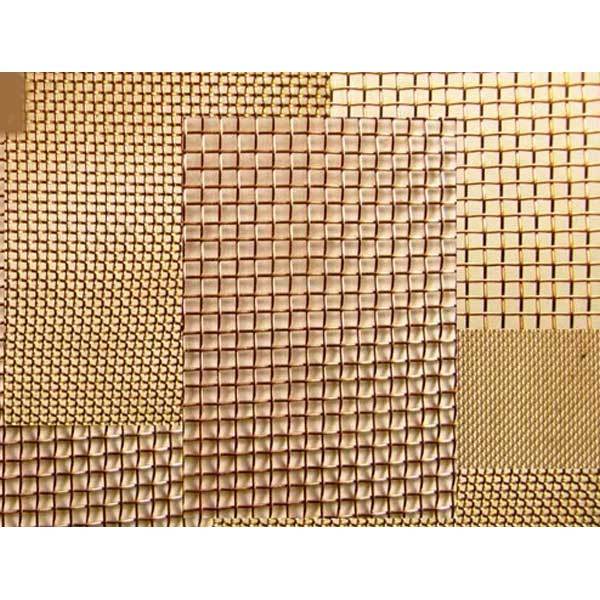
Woven copper wire mesh (plain and twill weave)
Woven formats dominate the fine-mesh and filtration end of the market. In plain weave — the most common structure — each warp wire passes alternately over and under each weft wire, producing a stable, uniform opening. Twill weave, where each wire passes over two and under two, allows finer wire diameters to be used at higher mesh counts without sacrificing structural integrity. This is why copper wire cloth used for filtration or as a copper EMF shielding mesh frequently uses twill construction at counts above 100 mesh per inch.
Actual testing in filtration environments shows that plain-weave copper mesh at 40–80 mesh per inch provides predictable, cleanable performance for liquid and air filtration in non-corrosive media. The open-area percentage in plain-weave copper wire mesh typically ranges from 25% (fine, high-mesh-count cloth) to over 60% (coarse, low-mesh-count screen). Copper mesh screen products used as decorative copper wire screen for architectural applications often use an intermediate weave specification — open enough for visual transparency, tight enough for structural stability.
Welded copper wire mesh
Copper welded wire mesh is manufactured by resistance-welding wire intersections rather than weaving them. The result is a rigid grid structure that holds its shape under mechanical loading far better than a woven equivalent at the same wire diameter. In practice, welded copper mesh is less common than welded steel or stainless versions because the process is more material-intensive and copper's softness can complicate consistent weld quality at very fine pitches. Where it does appear — particularly in cage construction, EMI containment panels, and copper hardware cloth configurations — it offers superior dimensional stability and predictable aperture size.
Expanded copper mesh and knitted copper wire
Expanded copper mesh is made by slitting and stretching a solid copper sheet, creating a diamond-pattern net without any joints or welds. The seamless structure gives it very high electrical continuity across the surface — an important property for copper Faraday cage mesh and grounding applications. Knitted copper wire, by contrast, uses an interlocked loop structure similar to a fabric. It is highly conformable, compressible, and is the format most often used in gasket sealing and cable shielding applications rather than flat panel uses.
Mesh count, wire diameter and opening size: how to read specs
Reading a copper wire netting specification sheet without understanding the three core parameters — mesh count, wire diameter, and aperture (opening) size — makes it nearly impossible to compare products accurately or confirm fitness for purpose.
Understanding mesh count (mesh per inch)
Mesh count is the number of openings per linear inch in one direction. A "40-mesh" copper screen has 40 openings per inch; a "200-mesh" screen has 200. Higher mesh count does not automatically mean smaller openings unless you also know the wire diameter. Two 100-mesh screens made from different wire diameters will have meaningfully different aperture sizes and open-area percentages.
The relationship between these three parameters follows a straightforward formula: Aperture = (1 / Mesh Count) − Wire Diameter. This means that to calculate the actual opening size in any copper wire mesh product, you need both the mesh count and the wire diameter — neither figure alone is sufficient.
| Mesh count (per inch) | Typical wire diameter (inches) | Aperture size (inches) | Open area (%) | Common application |
|---|---|---|---|---|
| 4 × 4 | 0.063 | 0.187 | 56% | Rodent exclusion, copper hardware cloth |
| 16 × 16 | 0.025 | 0.0375 | 36% | Copper insect screen, window/door screen |
| 40 × 40 | 0.010 | 0.015 | 36% | Fine filtration, air filtration pre-filter |
| 80 × 80 | 0.0055 | 0.0070 | 31% | EMI shielding, copper EMF shielding mesh |
| 200 × 200 | 0.0021 | 0.0029 | 33% | Laboratory filtration, fine copper mesh research |
Wire gauge standards used in copper mesh products
Wire diameter in U.S.-market copper mesh products is most often expressed in decimal inches or AWG (American Wire Gauge). Be aware that the AWG scale runs inversely — a higher AWG number means a thinner wire. AWG 18 wire (0.0403 inches) is considerably heavier than AWG 30 (0.0100 inches). When comparing copper screen wire specifications across suppliers, it is safer to use the decimal inch or millimeter value directly rather than relying on gauge designations, which can vary slightly by standard.
Alloy grades and material composition
Not all copper mesh products are made from the same material — and understanding the alloy designation is essential to predicting corrosion behavior, electrical performance, and long-term cost.
C11000 electrolytic tough pitch (ETP) copper
C11000 is the most common alloy used in copper wire netting for electrical and EMI applications. It is 99.9% pure copper with minimal oxygen content, delivering full IACS conductivity. When a product is described as "pure copper mesh" without further qualification in a U.S. industrial context, C11000 is typically what is meant. This is the alloy of choice for copper Faraday cage mesh, EMF shielding installations, and any application where electrical performance is the primary driver.
Brass (C26000), phosphor bronze (C51000), and other alloys
Brass wire mesh — alloy C26000, a 70/30 copper-zinc blend — is harder and more springy than ETP copper, making it well suited to woven copper wire cloth applications where dimensional stability under tension matters. However, its conductivity is roughly 28% IACS, significantly lower than pure copper, which disqualifies it for serious EMI shielding work. Phosphor bronze (C51000) adds tin and trace phosphorus for enhanced corrosion resistance and fatigue strength, making it the preferred alloy for marine-environment screening and fine filter cloth exposed to cyclic mechanical stress.
"The copper alloy designation is the single most important piece of information missing from most consumer-facing mesh product listings. Conductivity, corrosion behavior, and service life all vary substantially between C11000, C26000, and C51000 — treating them as interchangeable is one of the most common and costly specification errors we see." — Industry consensus view among wire mesh fabricators, 2026.
One persistent market confusion worth flagging: a reddish surface color does not confirm pure copper content. Brass with a low zinc content and some copper-coated steel products can appear nearly identical to ETP copper sheet. The reliable verification methods are a conductivity meter reading (pure copper will show close to 100% IACS) or a basic acid spot test available from materials testing suppliers.
Application guide: matching mesh type to use case
The single most common buying mistake is selecting a copper wire netting product based on appearance or price without mapping it to application requirements. The following breakdown covers the four primary use categories in order of market volume.
Rodent exclusion and pest control
For rodent exclusion — the highest-volume consumer application for metal wire netting — the critical specification is aperture size. Mice can compress their bodies through openings as small as ¼ inch (6.35 mm); rats require approximately ½ inch (12.7 mm) to pass. This means effective rodent-proofing demands apertures no larger than ¼ inch, which corresponds roughly to a 4×4 copper hardware cloth at standard wire diameters.
Why does copper outperform galvanized steel in this application? It does not rust when exposed to moisture and organic material inside wall voids, it resists gnawing better than steel wool (which compresses and rusts), and it does not create galvanic corrosion issues when in contact with copper plumbing — unlike galvanized products. A common misconception persists that copper "repels" rodents through smell or electrical charge. It does not. Copper wire netting works purely as a physical barrier. It must be correctly sized, fully packed into voids, and secured at edges to be effective.
EMI and RF shielding
For copper EMF shielding mesh and copper Faraday cage mesh applications, the governing specification is shielding effectiveness (SE), measured in decibels. SE is a function of mesh conductivity, aperture size relative to the target frequency's wavelength, and the number of mesh layers. As a general rule, a single layer of fine copper mesh (80–200 mesh, C11000) provides 40–60 dB of attenuation at frequencies below 1 GHz — adequate for most RF-quiet room installations but insufficient for military-grade MIL-STD-461 compliance without additional treatment.
In 2026, demand for copper EMI shielding mesh in the U.S. market is growing alongside data center expansion and EV manufacturing infrastructure, both of which require controlled electromagnetic environments. This has accelerated domestic sourcing interest, partly in response to import tariff increases on semi-finished copper products introduced in recent trade policy adjustments.
Insect screening and garden applications
Copper insect screen for windows and doors typically uses a 16×16 or 18×16 mesh count with wire diameters in the 0.011–0.025 inch range. This configuration blocks common insect vectors while maintaining reasonable airflow and visual transparency. Copper garden netting serves a different function — protecting plants from insects, birds, and small mammals — and typically uses a coarser mesh (¼ inch to ½ inch aperture) in a lighter wire gauge to reduce weight and allow light penetration. Both formats benefit from copper's natural antimicrobial surface, which inhibits algae and mold buildup in damp garden environments.
How to evaluate quality and avoid common buying mistakes
Evaluating copper wire netting quality is more nuanced than checking a product image or reading a description. Several recurring issues in the market can lead buyers to receive material that underperforms — or simply isn't what was specified.
Verifying alloy content and avoiding misrepresentation
As noted earlier, visual inspection alone cannot confirm copper alloy content. For high-value applications — EMI shielding, electrical grounding, laboratory filtration — request a mill certificate (also called a certificate of conformance) that states the alloy designation, wire diameter, and mesh count. Reputable suppliers will provide this documentation as a matter of course. Absence of documentation is a meaningful quality signal.
Galvanic corrosion is a real risk when copper mesh contacts dissimilar metals. Copper is relatively noble in the galvanic series, which means that aluminum frames, galvanized hardware, or zinc-coated fasteners in contact with copper woven wire mesh in a wet environment will corrode preferentially. This is not a reason to avoid copper wire netting — it is a reason to specify compatible hardware and isolation materials at installation points.
A step-by-step specification checklist before purchasing
- Define the application category: rodent exclusion, insect screen, EMI shielding, filtration, or decorative.
- Determine the required maximum aperture size based on the target exclusion size or filtration particle size.
- Specify the alloy: C11000 for electrical/shielding applications; C26000 brass for structural/decorative; C51000 phosphor bronze for corrosive or fatigue-loaded environments.
- Confirm wire diameter and calculate open-area percentage using the aperture formula.
- Assess the installation environment: indoor/outdoor, moisture exposure, contact with other metals.
- Request a mill certificate or material certification from the supplier.
- Verify roll or sheet dimensions and edge finish — raw-cut edges on fine copper wire cloth can unravel if not properly finished.
Understanding oxidation — patina vs. corrosion
Copper naturally oxidizes when exposed to air and moisture, progressing from the familiar bright red-orange through brown and eventually to the blue-green patina (verdigris) associated with aged copper surfaces. For most copper wire netting applications, surface oxidation is cosmetic and does not affect structural integrity or functionality. The exception is in high-precision filtration applications, where surface oxides can alter effective aperture size over time, and in electrical contact applications, where oxidation increases surface resistance. In these contexts, specifying bright-annealed or electropolished copper wire cloth adds meaningful service life.
Installation and maintenance considerations
Even the best-specified copper wire netting will underperform if installed or maintained incorrectly. The following principles apply across most application categories.
Cutting, forming and edge treatment
Fine copper wire mesh — anything above 40 mesh per inch — should be cut with sharp aviation snips or, for precision work, a rotary cutter on a firm backing surface. Tearing or using dull scissors creates unraveled wire ends that can become sharp protrusions and compromise the mesh edge integrity. For applications where the mesh edge is exposed (window screens, shielding panels), a folded hem or a metal channel frame prevents progressive unraveling. Coarser copper hardware cloth and copper chicken wire can be cut with standard wire cutters without edge treatment concerns.
Fastener selection and frame compatibility
Just as the mesh alloy matters, so does the hardware used to install it. For copper screen wire and copper woven wire mesh applications, use copper, brass, or stainless steel fasteners and frames. Aluminum frames are common in window screen applications and are generally acceptable when the contact area is limited and dry — but in persistently wet environments, an isolation barrier (rubber gasket or neoprene tape) between the copper mesh and aluminum frame is advisable. Steel staples and galvanized nails in direct contact with copper mesh in outdoor, wet conditions will corrode and stain surrounding surfaces within one to two seasons.
Cleaning and long-term maintenance
Copper mesh screen in window and door applications should be cleaned periodically with a soft brush and mild soap solution — avoid abrasive cleaners or steel wool (which will contaminate the copper surface and accelerate corrosion). For decorative copper wire screen applications where a bright finish is desired, a light application of a copper-compatible metal polish followed by a clear lacquer coating will slow patina development substantially. Of course, for garden and rodent-exclusion applications where appearance is secondary to function, no surface treatment is needed or recommended — the natural patina actually adds a degree of surface hardness over time.
Metal wire netting used in filtration service should be inspected regularly for wire fatigue, which presents as small fractures near weld points or weave intersections. In cyclic-flow or vibration environments, even high-quality copper woven wire experiences fatigue failure well before the material corrodes. Replace filter cloth panels at the first sign of broken wire ends rather than waiting for visible aperture distortion.
Frequently asked questions
Q: What mesh count of copper wire netting is best for keeping mice out?
A: For mouse exclusion, use copper hardware cloth with a maximum ¼-inch (6.35 mm) aperture, which corresponds to a 4×4 mesh at standard wire diameters. Anything coarser allows juvenile mice to pass through. The mesh must be packed tightly into voids and mechanically secured — loose installation negates the physical barrier entirely.
Q: Is copper mesh better than stainless steel for EMI shielding?
A: For EMI shielding effectiveness, C11000 copper wire mesh outperforms stainless steel because of copper's significantly higher electrical conductivity (100% IACS vs. approximately 2–3% IACS for 304 stainless). At equivalent mesh count and wire diameter, copper provides higher shielding attenuation in dB. Stainless is preferred only where corrosion resistance or mechanical hardness outweighs the conductivity requirement.
Q: Will copper wire netting rust or corrode outdoors?
A: Pure copper does not rust in the way iron does. It oxidizes gradually, developing a brown then green patina (verdigris) that is largely self-limiting and does not weaken the wire structurally. The main outdoor corrosion risk is galvanic corrosion when copper contacts dissimilar metals like aluminum or galvanized steel in wet conditions. Use compatible fasteners and isolation materials to prevent this.
Q: How do I tell if a product labeled "copper mesh" is actually pure copper?
A: Visual color is not reliable — brass and some copper-coated products appear similar. Request a mill certificate stating the alloy designation (C11000 for pure copper). For field verification, a conductivity meter will show close to 100% IACS for ETP copper. Brass (C26000) will read approximately 28% IACS. An acid spot test kit is another low-cost verification option.
Q: What is the difference between copper wire cloth and copper hardware cloth?
A: Copper wire cloth refers to finely woven mesh with mesh counts typically from 20 to 500 per inch, used for filtration, EMI shielding, and precision screening. Copper hardware cloth is a coarser welded or woven product with openings from ¼ inch to 1 inch, used for construction, rodent exclusion, and garden protection. They overlap in material but differ in construction precision and target application.
Choosing the right copper wire netting comes down to aligning four variables — alloy grade, mesh count, wire diameter, and fabrication method — with the demands of your specific application. Whether you are sourcing fine copper mesh for an RF shielding project, specifying copper screen wire for a window installation, or selecting copper hardware cloth to seal a pest entry point, the specification framework in this guide provides a reliable basis for comparison. Given 2026 supply dynamics, including upward cost pressure from trade policy on imported copper semi-products, it is also worth building alloy documentation requirements into your procurement process as a standard practice rather than an afterthought.
Key words:
RELATED INFORMATION

What is galvanized welded mesh? Uses, gauges, and coating types compared
2026-11-16

Welded wire mesh buying guide: types, sizes, and applications explained
2026-11-16

What is welded screen mesh? Types, uses, and buying guide
2026-11-16
PRODUCT SEARCH
Quickly find the products you need
Surpass Oneself, Pursue Advanced
PRODUCT SOLUTION
To provide you with industry solutions
Please leave the information you want to consult


Service E-mail
Service TEL
Address
Hengshui HeBei China
Our Main Products
Powerby:300.cn | Label | Privacy Policy